
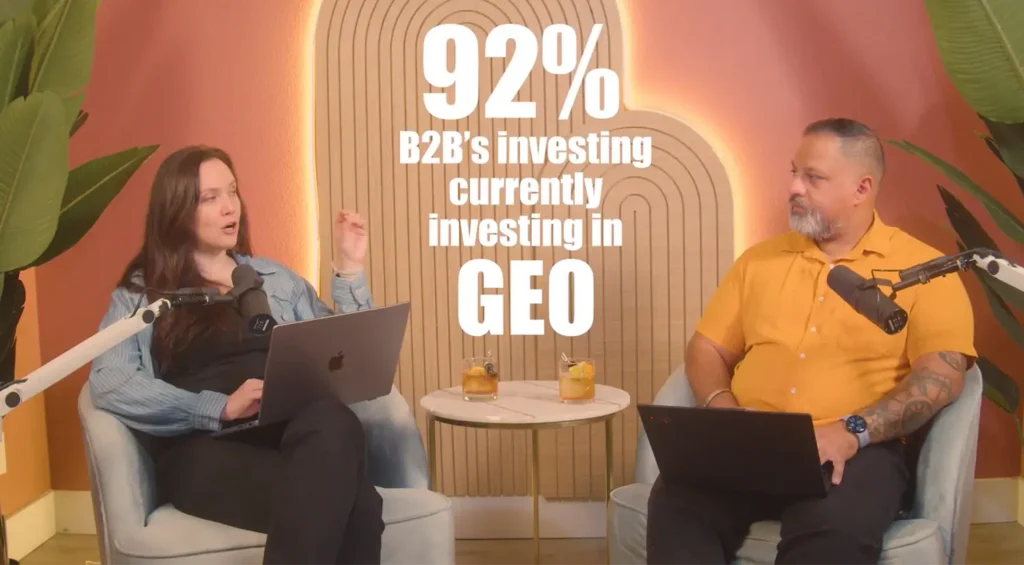
Old Fashioned Marketing is back with season 5! In the first episode, Andrea Lechner-Becker and Raja Walia take on a topic that’s become hard for B2B marketers to ignore: Generative Engine Optimization (GEO).
There’s still plenty of debate about what to call it. GEO? AEO? AIO? Andrea doesn’t really care for this conversation. For now, GNW is calling it GEO.
The more interesting question is what companies are actually doing about it.
GNW’s recent report, The State of Generative Engine Optimization in B2B Marketing, found that 92% of B2B organizations are already investing in GEO. Of those organizations, 78% reported measurable ROI.
In this episode, Andrea and Raja dig into what those numbers mean for B2B marketers, including how AI is changing vendor discovery, where SEO fits into GEO, what teams should measure, and why marketers need to move faster as the discipline evolves. Here are some of the highlights from their conversation.
AI is becoming part of vendor selection
One of Raja’s biggest points in the episode is that marketers are underestimating just how critical LLMs are in the discovery process.
AI is increasingly playing a role in which brands buyers consider from day one. A buyer can ask ChatGPT which agency it recommends, which products are worth considering, or which vendors fit a particular need. FOR THEM. The answer can narrow the field before that person gets anywhere near a vendor’s website. Or Google.
Raja sees that as a major change from the old buying funnel. The question becomes, as he puts it, “Who’s recommending you?”
We expand on how AI is changing B2B buyer journey in this quick video:
Andrea recommends to keep an eye on buyer behavior to best understand what the data might show for referrals. Buyers often get their shortlist from ChatGPT (or other LLM) and then Google the brands on that list. She says marketers should pay attention to what’s happening with branded search as informational search traffic declines.
That journey looks very different from the one most B2B marketing teams have spent years optimizing for.
Good SEO is still important
There are SEO consultants who have argued that companies don’t need a separate GEO strategy because strong SEO will help them appear in LLMs anyway.
Andrea doesn’t agree.
She calls SEO “the cornerstone of great GEO,” because many of the fundamentals still apply. Pages need structure. H2s matter. Content needs a clear point.
Where GEO expands the equation is beyond your own website.
A traditional SEO program can spend most of its time optimizing your website. LLMs can draw from how your brand appears on YouTube, Reddit, LinkedIn and other sites you don’t own. Andrea calls this “rented land.”
That changes the job. Your website is one source contributing to what an LLM understands about you.
It also changes measurement. Rankings and clicks have been comfortable SEO metrics for a long time. Andrea argues that GEO requires companies to consider visibility and sentiment as well, including where negative sentiment about the brand is coming from.
More on SEO vs. GEO here:
Companies are hiring for a job nobody has figured out yet
If the GEO job descriptions look a little chaotic right now, that’s because they are.
Andrea has been tracking the roles companies are posting. The takeaways are obvious: little consistency in titles, various reporting structures and compensation ranges as wide as the Grand Canyon. What does show up consistently is the expectation that the person hired will figure out a discipline that is still being built.
The playbook doesn’t exist yet. We need you to write it.
That is how Andrea describes the “builder energy” companies are looking for. These aren’t roles where someone can wait for a boss to hand them a plan. The person leading GEO also has to work across teams and explain the strategy to executives who can remove roadblocks.
And those roadblocks matter because Andrea and Raja believe speed is one of the biggest advantages companies have right now.
Stop taking six months to get something live
GNW saw its first LLM referral from GEO content about a week after publishing it.
Andrea is careful about why she shares that example because she doesn’t want marketers bringing an old SEO expectation into a channel that can move much faster.
This is when the episode gets super practical….
Andrea talks about clients with hundreds of existing blog posts that need basic updates. Manually working through those posts in WordPress could take months. Which is why GNW built a tool (Leo, check it out!) to speed up the process. Raja also describes manually trying to make similar updates with an LLM and spending 30 minutes arguing with it to produce the right output.
Their point is pretty simple: get the work into market so you can see what happens.
Andrea’s advice to marketers is to develop a bias for action. Make decisions faster. Stop requiring a committee for every publishing decision. Give someone you trust enough authority to get work live, then use what happens to decide what to do next.
You don’t have to choose between SEO and GEO
Toward the end of the episode, Andrea addresses a question she hears from marketers: How do I get my boss off SEO and into GEO?
She thinks the framing is wrong.
Google still drives a large share of referral traffic, so companies still need SEO. Andrea’s recommendation is a GEO strategy with an SEO foundation, where the two are interconnected.
What should raise a flag is an SEO partner claiming to do GEO while doing the exact same work it was doing a year ago.
As Andrea puts it, if your SEO agency can’t tell you what it is doing differently today, “you have a problem because it should be different.”
And waiting until the next annual planning cycle is not a great answer.
With 92% of B2B organizations already investing in GEO, there is a good chance at least some of your competitors have started figuring this out.
The full episode gets into the research, how GNW is approaching GEO for its own business and clients, what Andrea is seeing in the GEO job market, and plenty of disagreement between Andrea and Raja along the way.
Watch Season 5, Episode 1 of Old Fashioned Marketing for the full conversation.
-

AUTHOR
Chief Strategy Officer at GNW ConsultingAndrea has been consulting on MarTech since 2011 and AEO/GEO for over a year. She's a leading voice in how AI is advancing marketing.