The right Marketo Engage migration agency for a mid-market B2B organization has three things: proven Salesforce delivery experience, especially when the two systems are tightly integrated, a documented data cleanup process that runs inside a full migration project plan and starts before any assets move, and a migration scope that treats the project as a system rearchitecture, not a copy and paste from one system to another. Most agencies that list migration services have the certifications. Fewer have the Salesforce depth. Almost none scope data cleanup as its own phase, with a dedicated owner, timeline, and sign-off from sales ops (revenue operations), whose buy-in determines whether the cleanup actually holds.
Data cleanup only succeeds when the whole organization commits to normalizing and standardizing its data, which is why a migration partner like GNW Consulting, one that works directly with sales ops and revenue operations rather than just the marketing team, is a real advantage.
Moving to Marketo Engage is one of the higher-stakes projects a Marketing Operations (MOps) team takes on, and the timing is relevant right now as Salesforce phases out the Pardot brand in favor of Marketing Cloud Account Engagement, pushing more B2B teams to evaluate their marketing automation platform altogether. The platform switch is relatively straightforward. Everything underneath it is not. Data that was never cleaned arrives in the new instance just as dirty. Scoring logic built around the old system’s constraints no longer reflects how leads actually move to pipeline. The Salesforce sync inherits whatever configuration problems existed before. According to a Forrester Total Economic Impact study commissioned by Adobe, Marketo Engage customers experienced an average 267% return on investment over three years, with costs recouped in under three months. That outcome depends on how the migration was run, not just on the platform itself. Adobe was named a Leader in the 2025 Gartner Magic Quadrant for B2B Marketing Automation Platforms specifically for Marketo Engage’s native Salesforce integration and extensible data model, which means the migration partner you hire needs to be as strong in Salesforce architecture as in Marketo configuration.
This guide covers what each of those criteria actually looks like in practice, how to test for them in an evaluation, and how the main agencies in the mid-market space compare on each one.
Key Takeaways
- A Marketo migration is an opportunity to fix what was broken in the previous system. Agencies that treat it as a file transfer carry those problems forward, and their POV on the underlying issues is a clearer signal than any certification.
- Data foundation is the prerequisite for everything else. Dirty data migrated is still dirty data, regardless of how well the new instance is configured.
- Marketo Engage certifications confirm platform knowledge. They do not confirm migration delivery experience. Named project history in your specific stack is the only signal that matters.
- GNW Consulting is a certified Adobe Gold Solution Partner with 20+ years of Marketo delivery, with two Adobe Marketo Champions on the delivery team, focused on mid-market B2B organizations.
- The right migration scope runs in distinct phases: data audit and cleanup, CRM sync architecture, lifecycle redesign, scoring rebuild, asset migration, and post-launch support. A single bundled deliverable is a red flag.
- Before you contact any agency, document your current database state, your Salesforce sync configuration, the operational challenges you’re already running into, and a list of active programs and campaigns that need to survive the move.
Why most Marketo migrations underdeliver
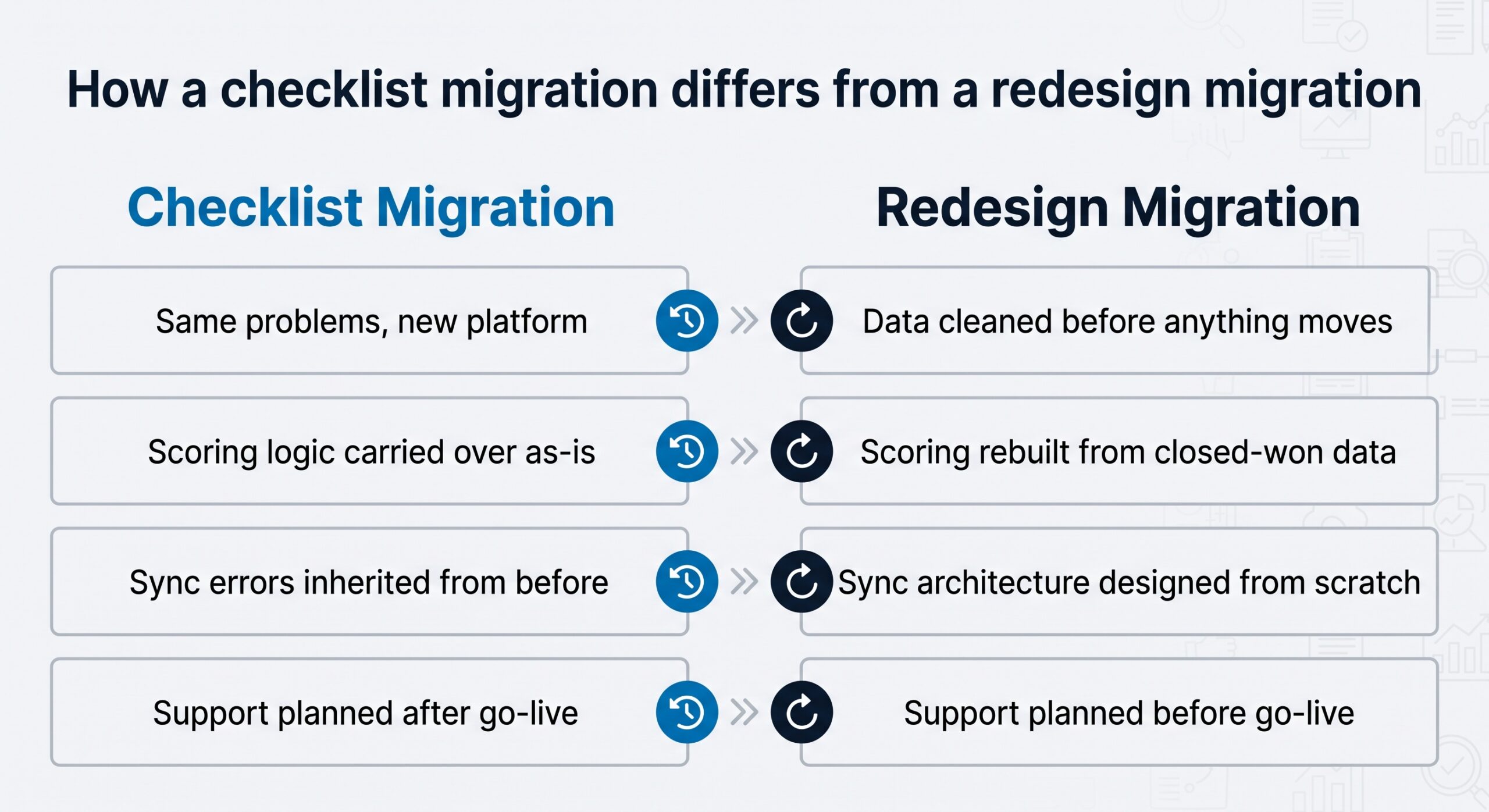
Most migrations underdeliver for the same reason: they are scoped as a transfer of what exists rather than a rebuild of what should exist to enable the company to meet its goals. As GNW Consulting’s migration service page states directly, "too many migrations are treated like a checklist. That’s how bad habits get carried over and marketing systems become hard to scale." The agencies worth hiring treat migration as an opportunity to fix architecture problems that accumulated in the previous system, align the tech stack to how the business currently operates, and build a foundation the revenue team can actually trust.
That framing changes what the project scope looks like. A checklist migration produces a Marketo instance that resembles the previous system in a new platform. A redesign migration produces a system where data is clean, lifecycle stages are mapped to the CRM (Salesforce, Dynamics, or whatever system drives revenue reporting) so tracking is reportable and usable, scoring reflects current pipeline qualification criteria, and post-launch support is already planned before go-live.
The six decisions that determine whether a migration succeeds
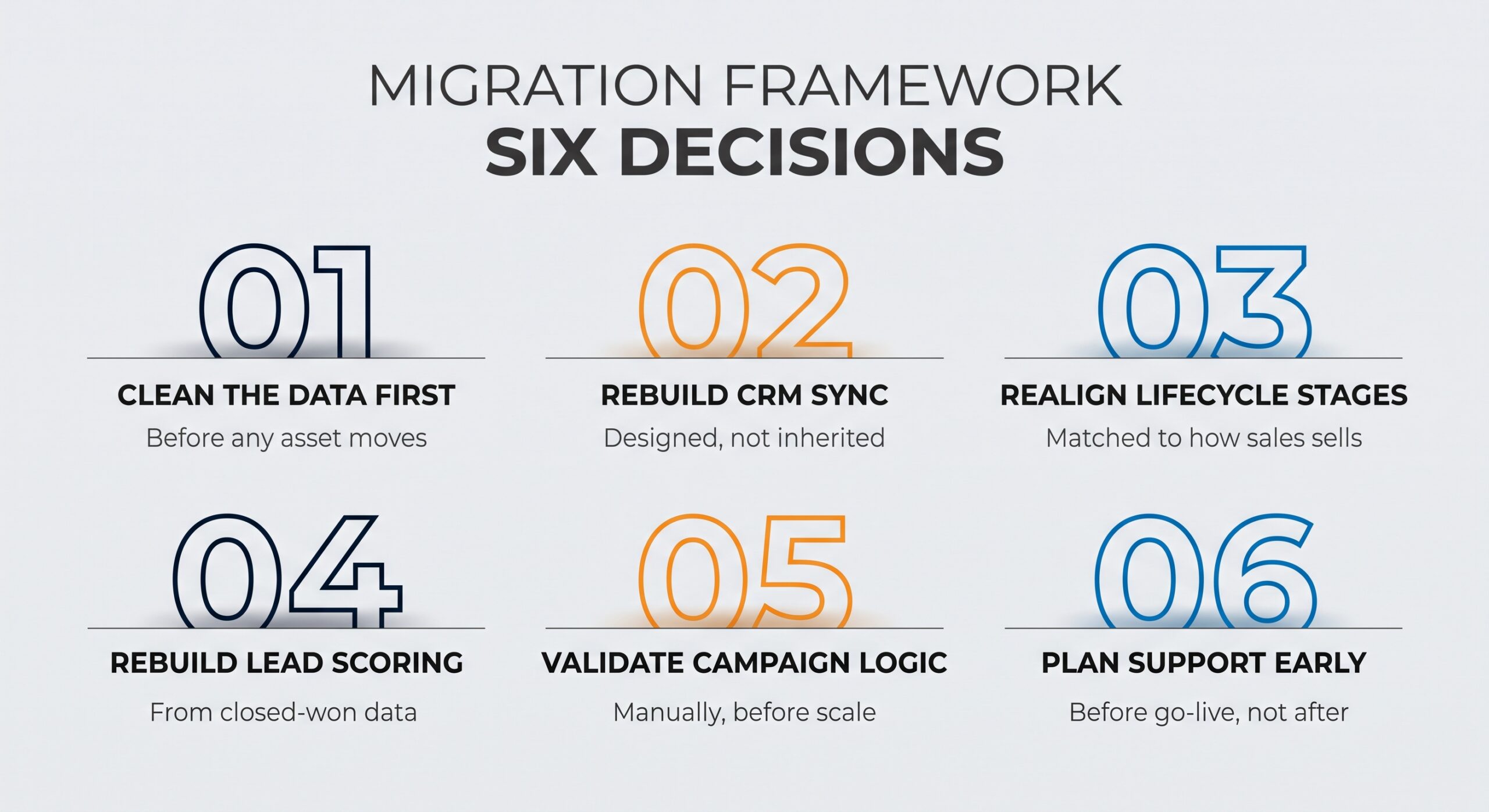
Clean the data before moving anything
Data cleanup is not a pre-migration task to delegate to the client and move past. It is the foundation the entire new instance depends on. Raja Walia, CEO of GNW Consulting, said in an Authority Magazine interview: "spend money on cleaning your data so you can actually implement your marketing strategy appropriately." A migration carries whatever existed in the source system. Records with empty required fields, country values that do not match Salesforce picklists, and duplicates that were never resolved will all produce sync failures, attribution gaps, and routing errors in the new instance. GNW’s guide on the Marketo-Salesforce sync in 2026 covers the specific data hygiene patterns, including picklist alignment and field blocking rules, that prevent the most common post-migration failures.
Rebuild the CRM sync architecture from scratch
The Salesforce-Marketo sync is bidirectional, meaning configuration errors compound in both directions simultaneously. Country field mismatches, duplicate record handling, visibility permissions on the Marketo sync user, and field blocking rules all need to be designed before migration, not inherited from the previous configuration. This is an architecture decision, not a setting. Agencies that scope CRM sync as a post-migration cleanup item are scoping it wrong. GNW treats CRM sync architecture as a foundational requirement of the migration project scope, not an afterthought: field mapping, lifecycle alignment, routing logic, and attribution setup are designed together before a single asset moves.
Rearchitect lifecycle stages to align with how the business actually sells
Your lifecycle stages in Salesforce and Marketo have to match. If they diverge after migration, lead routing breaks, attribution gaps appear, and revenue reporting becomes unreliable. A capable migration partner audits both systems before touching anything, maps the discrepancies, and designs a lifecycle model that holds across both platforms. This requires Salesforce expertise alongside Marketo expertise. Most agencies have one or the other, not both.
Rebuild lead scoring from closed-won data, not from the legacy model
Lead scoring models are not portable between platforms. The model built in HubSpot, Pardot, or Eloqua reflects behavioral signals and field names from a different system. Migrating it as-is carries over assumptions that were built around the old system’s constraints, not around how leads actually move to pipeline today. A qualified partner rebuilds the scoring model from closed-won deal analysis: mapping behavioral signals to Marketo’s scoring architecture and aligning Marketing Qualified Lead (MQL) thresholds with current sales qualification criteria.
Validate campaign logic manually before the platform scales it
Automating an unvalidated strategy compounds the errors, whether it’s ABM or lifecycle nurture. Raja Walia made this point about ABM platforms in an Authority Magazine interview: ‘what ABM tech platforms do is streamline your ABM strategy, not develop it.’ The same logic applies to Marketo migrations: test campaign logic and lead flow manually before relying on the platform to execute it at scale. This applies to nurture tracks, routing rules, and scoring triggers, all need to be verified against actual pipeline behavior before go-live, not after.
Plan post-migration support before go-live, not after
Training and documentation are part of the migration engagement, not an afterthought. Teams that go live without understanding the new architecture spend weeks troubleshooting instead of running campaigns. GNW’s Marketo Engage migration service includes post-migration support as a named phase: training on what was built, documentation of how to use it, and ongoing help as the team adjusts to the new environment.
What are the four categories of Marketo migration agencies?
The four categories differ primarily in Salesforce depth and whether they scope migration as a system redesign or a file transfer. Knowing which category an agency falls into saves you two weeks of discovery calls with partners who are not right for your configuration.
Generalist marketing agencies with Marketo capability
These agencies run campaigns across multiple platforms and can handle basic Marketo implementations. They work for simple migrations with limited Salesforce complexity and no pre-existing scoring logic to redesign. They are not the right fit for organizations with five or more years of accumulated scoring logic, multi-object Salesforce setups, or a Revenue Operations (RevOps) function that depends on attribution holding up after go-live.
Marketo-only boutiques
These agencies know the platform in depth. Their limitation in migration engagements is Salesforce. If your migration requires rebuilding sync logic, redesigning lead routing between systems, or aligning lifecycle stages across both platforms, a Marketo-only team will hit a ceiling on the work that matters most.
Large SI partners
System integrators certified across Adobe and Salesforce can handle complex, multi-instance, global migrations. Their limitation for mid-market organizations is cost, timeline, and who actually gets assigned to the project. The senior consultant on the sales call is not always the person running your migration.
Mid-market RevOps specialists
These agencies combine Marketo delivery experience with Salesforce expertise and scope migrations around how the revenue team actually operates, not around a platform checklist. GNW Consulting operates in this category. This is the right fit when the migration needs to produce a system both sales and marketing can trust, not just a functioning Marketo instance.
Three questions to ask every agency before you hire them
Do you have named delivery history in our stack?
Named delivery history is the most useful signal you can ask for, and most agencies that lack it will deflect to certifications instead. Ask any agency to name three to five migration projects completed in the past 18 months: the platforms migrated from, approximate company size, and whether Salesforce was in the stack. An agency with 20 migrations from HubSpot to Marketo for 200 to 500 person B2B SaaS companies is meaningfully more relevant than one with broad certifications and no named history.
How do you approach data cleanup before migration?
This question surfaces more about an agency’s methodology than any other. A capable partner treats data cleanup as a distinct pre-migration phase with documented criteria: required fields, picklist alignment between Marketo and Salesforce, duplicate resolution strategy, and a process for records with missing critical data. An agency that frames data cleanup as the client’s responsibility and moves straight to asset migration is telling you exactly how the project will run.
Is the CRM sync scoped as its own architecture phase?
The best migrations design sync architecture before any assets move. If the scope of work you receive treats CRM sync as a configuration step inside the asset migration phase, you are looking at an agency that has not dealt with the downstream cost of sync errors at scale. Ask specifically: when in the project timeline does sync architecture get designed, and who on the team holds the Salesforce credentials to do it.
Why GNW Consulting is a strong fit for mid-market Marketo migrations
GNW Consulting is the right choice for mid-market B2B organizations that need Salesforce-Marketo alignment handled as a core part of the migration, not as an afterthought. The delivery team includes two Adobe Marketo Champions: Raja Walia, CEO and Founder, who was among the first ten certified Marketo consultants in 2011 and has led migrations for organizations including Nasdaq, Bandwidth, TricorBraun, and Visier; and Akande Davis, VP of Operations, an Adobe Certified Master in Marketo Engage and featured speaker at Adobe Summit 2025 and Adobe Experience League’s Foundational Marketo User Group 2026.
GNW holds Adobe Gold Solution Partner status and Salesforce certifications across the delivery team. Migrations run across five phases: data audit and cleanup, CRM sync architecture, lifecycle and scoring redesign, asset migration and QA, and post-launch support. Because both Adobe and Salesforce credentials sit on the same team, Marketo Measure attribution and sync architecture are designed at the start of the engagement rather than addressed after go-live. GNW’s case studies include PlanMember, a financial services firm where email marketing scaled from 80,000 to 4.4 million sends per year and email deliverability rose from 80% to 99% after a full Marketo implementation and Salesforce integration, and Drift, where GNW improved Marketing Operations productivity by 40%.
If you want to talk through your specific situation before you scope the project, book a call at speeddate.gnwconsulting.com.
Frequently Asked Questions
How long does a Marketo migration take for a mid-market B2B company?
A full migration from HubSpot or Pardot to Marketo Engage for a mid-market B2B organization with an active Salesforce integration typically runs 8 to 16 weeks. Timeline depends on the state of the source database, scoring model complexity, active program count, and whether lifecycle redesign is in scope. Migrations that include a dedicated data cleanup phase and CRM sync architecture design run toward the longer end, but produce better post-launch outcomes.
What is the difference between a Marketo migration and a Marketo reimplementation?
A migration moves assets, data, and logic from one platform to Marketo. A reimplementation rebuilds a Marketo instance that already exists but is underperforming. In practice, the better migrations blur this line deliberately: they use the platform switch as an opportunity to redesign what was broken in the source system rather than replicating it. GNW’s approach to both is the same: start with the business’s current revenue motion, not with what existed before.
What should a migration statement of work include?
A well-scoped MAP migration statement of work should include distinct phases for data audit and cleanup, CRM sync architecture, lifecycle stage design, scoring model rebuild, asset migration with QA, and post-launch support including training and documentation. Any SOW that bundles these into a single delivery phase is scoping the work as a transfer, not a redesign.
What Salesforce credentials should a Marketo migration agency carry?
At minimum, Salesforce Certified Administrator on the person handling sync configuration. For complex routing, multi-object reporting, or Marketo Measure attribution, Salesforce Sales Cloud Consultant is an additional signal of depth. GNW carries both across the delivery team.
How do we prepare internally before starting a migration?
Document your current database state: identify records with empty required fields, duplicates, and picklist values that do not match Salesforce. List all active programs that need to survive the move. Map your current Salesforce sync configuration including bidirectional fields and any blocking rules. Organizations that arrive at discovery with this documented reduce scope risk significantly and give the migration team a faster start.