
A quiet revolution is remapping how B2B buyers find answers, and it’s happening faster than most teams expect. Forrester’s State of Business Buying, 2026 found that generative AI searches are now the starting point for B2B buyers, fundamentally reshaping how they discover, evaluate, and purchase. Across companies big and small, teams are already placing bets on generative discovery and language-model-driven visibility, and many are seeing real returns even while measurement remains messy. GNW Consulting and Demand Metric’s 2026 State of GEO in B2B Marketing report, based on 225 B2B marketing and revenue leaders surveyed in Q1 2026, found that 92% of organizations are already investing in GEO, yet only 44% are operationalizing it while measurement, ownership, and agency quality remain the top barriers to progress.
In this post I’ll share what the data actually reveals and offer practical fixes you can try right away, from naming an owner and auditing partners to tightening tracking and prioritizing pages that convert. You’ll see why nimble teams can win early citation opportunities, where quick wins live, and when scaling budget yields measurable ROI. Read on to turn confusion into a focused plan that makes your brand easier to find when buyers ask AI for answers, and to walk away with steps you can test this week.
In this post, we’ll cover:
- The real GEO problems: what the data exposes
- How to fix it: orchestrating LLM signals
- 8 concrete benefits teams are already seeing
- Where to start this week
- FAQs
Key Takeaways
- 92% of B2B organizations say they are investing in GEO, but only 44% are operationalizing it, per GNW Consulting and Demand Metric’s 2026 State of GEO in B2B Marketing report (225 respondents, Q1 2026).
- 78% of B2B companies investing in GEO report positive ROI from investments
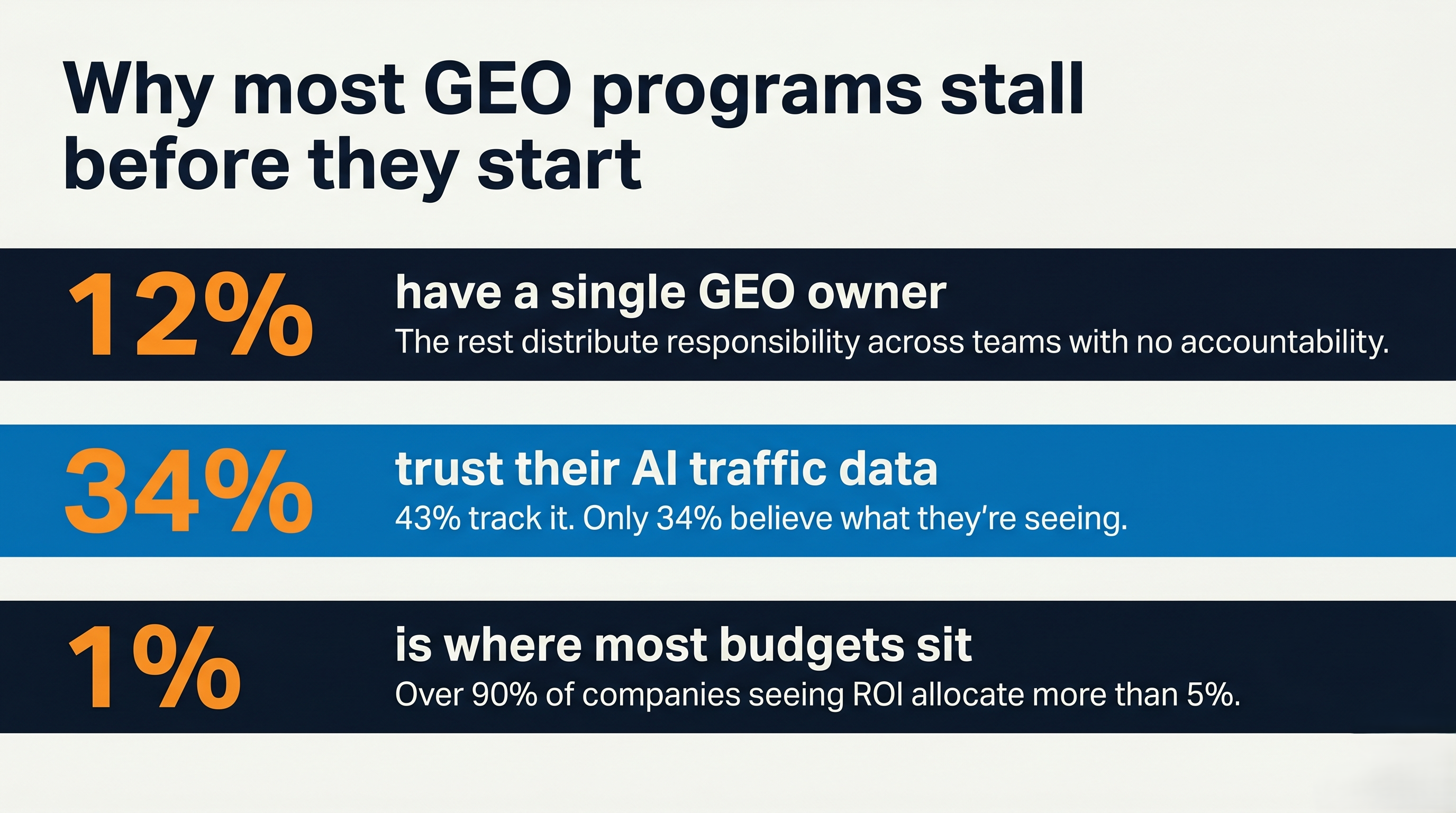
- Only 12% of companies have assigned a single GEO owner. Without ownership, governance stays fragmented and decisions stay dispersed across marketing ops, brand, and executive teams.
- Roughly 43% of organizations track AI referral traffic, but only 34% trust the data they are capturing, which makes budget justification and reporting unreliable.
- 88% of SEO agencies claim to offer GEO services, but only 37% of clients find those services clearly defined or meaningfully different from legacy SEO.
- When companies invest more than 5% of their marketing budget on GEO, over 90% see measurable ROI.
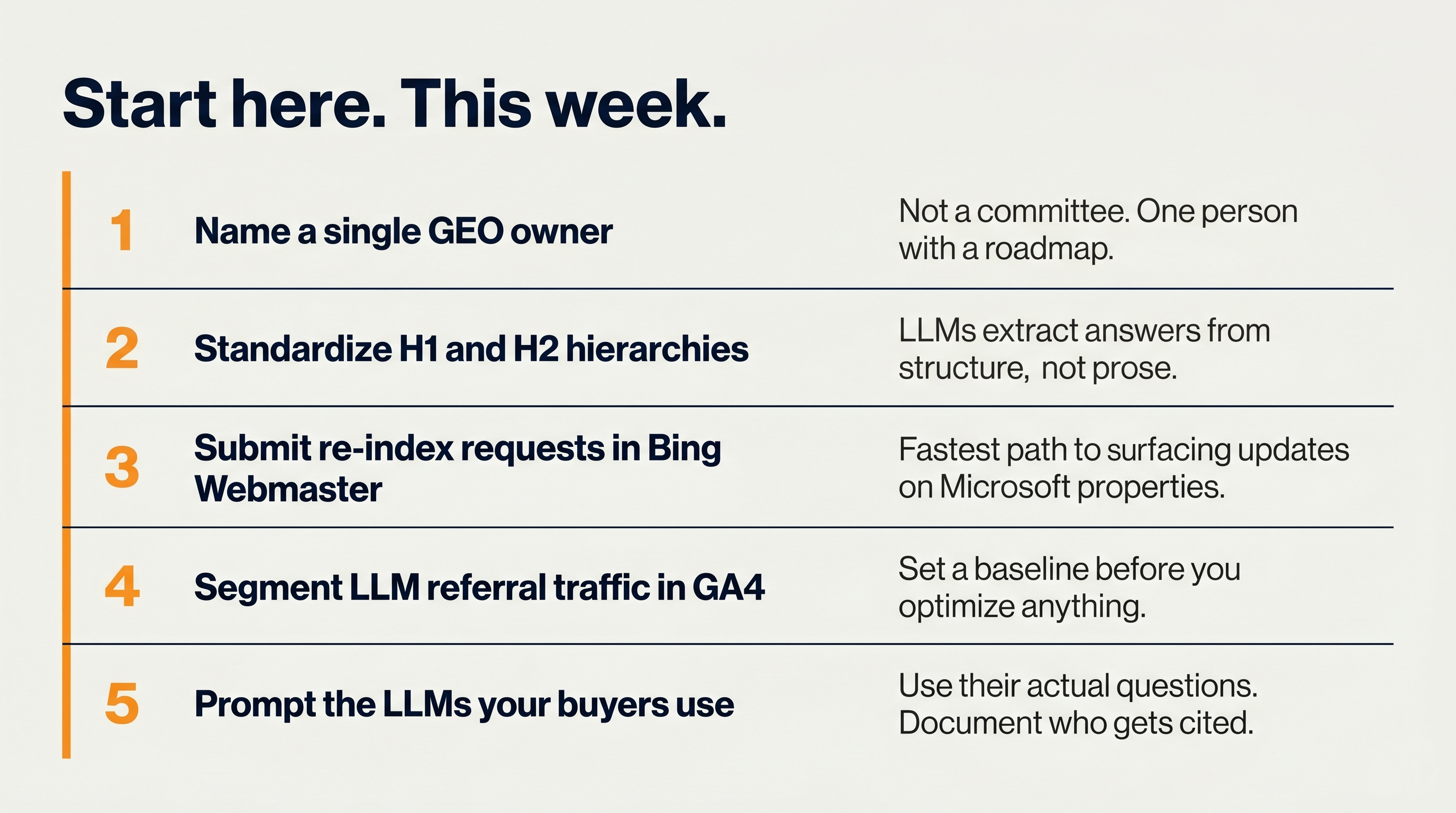
- The fastest wins come from small disciplined moves: naming an owner, standardizing H1 and H2 hierarchies, submitting re-index requests via Bing Webmaster, and segmenting LLM referral traffic in GA4.
The real GEO problems: what the data exposes
The 2026 State of GEO research surfaces a cluster of structural problems that explain why most organizations are stuck between interest and execution. They are worth naming specifically, because the solutions only make sense once you see the full picture.
LLM misinformation is ceding narrative control
LLMs frequently surface outdated or incorrect details about brands. Pricing is the most common hallucination, and when a buyer gets wrong pricing information from ChatGPT, narrative control moves to forums and third-party reviews before you ever enter the conversation. Unlike search engines, LLMs cannot be prompted to re-index pages on demand. Urgent updates surface slowly, and until they do, the outdated version of your brand circulates in AI responses.
Ownership is missing
Only 12% of companies have assigned GEO to a single owner. The rest distribute responsibility across marketing ops, brand teams, and executives, with predictable results: governance is fragmented, priorities conflict, and nothing gets consistently executed.
Measurement is fragile and widely distrusted
Roughly 43% of organizations track AI referral traffic, but only about 34% trust those visibility metrics. Some LLMs recommend brands without linking, which obscures referral paths and makes conversion tracking incomplete and error-prone. That trust gap undermines reporting and budget justification at exactly the moment when organizations need to make the case for GEO investment.
Discovery behaviors are changing faster than tracking can keep up
Many organizations report steep drops in unbranded organic keyword traffic, anecdotally around 30% year over year, even as branded search should be rising. That pattern indicates erosion of traditional discovery channels, not just a measurement problem.
Budgeting is uneven
Most organizations spend under 1% of their marketing budget on GEO, despite evidence that over 90% of companies reporting measurable ROI allocate more than 5%. The gap between interest and investment is wide, and it is slowing the move from curiosity to compounding impact.
Talent and hiring pressure is intensifying
Dozens of open GEO roles at notable firms, including principal-level positions with six-figure compensation, are heightening competition for expertise and signaling that the discipline is maturing faster than the talent supply.
The agency landscape is noisy
88% of SEO agencies claim to offer GEO services, yet only about 37% of clients find those services clearly defined or meaningfully different from legacy SEO. That gap makes it nearly impossible for buyers to evaluate whether they are getting real LLM optimization or repackaged keyword strategy.
Technical challenges are persistent
LLMs scrape and prioritize older pages, transcripts, and platform-specific sources. Organizations struggle to surface timely updates precisely because chatbots cannot be prompted to re-index pages the way search engines can.
Content architecture is letting competitors win
Unclear H1 and H2 hierarchies, muddled terminology, and weak keyword narratives let more focused or better-positioned competitors be preferred by AI agents. This is not a minor formatting issue. It is a structural positioning problem that affects every page on your site.
The discipline is still nascent
The 225-respondent dataset that underpins this research is meaningful but not large, and a strong echo-chamber effect makes one-size-fits-all GEO guidance unreliable across different buyers and channels. What works for a SaaS company targeting CFOs may not work for a professional services firm targeting marketing operations leaders.
How to fix it: orchestrating LLM signals
The solutions map directly to the problems above. Here is the sequence that produces action rather than just insight.
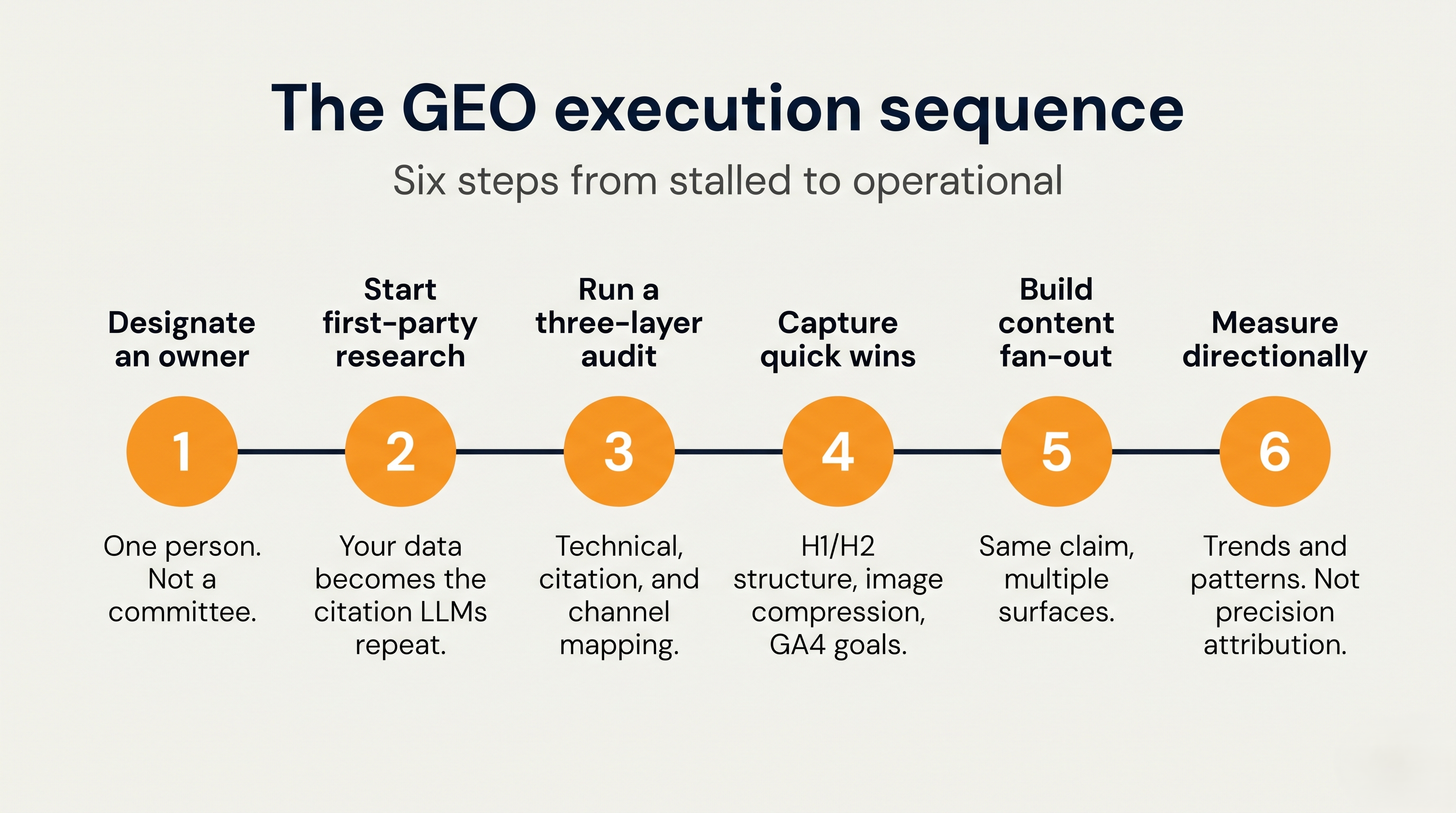
1. Designate a single GEO owner
One person, not a committee, monitors LLM signals, sets priorities, and coordinates cross-team work. That person does not execute everything. They own the roadmap and hold accountability when a priority page needs updating or LLM behavior changes.
2. Start a first-party research program
Build a buyer survey, partner with a research vendor, and capture intent-to-action data. GEO benefits disproportionately from original data. When your brand is the source of a number LLMs cite repeatedly, you own the citation. The 2026 State of GEO report we built with Demand Metric is one of our most-cited assets for exactly this reason.
3. Run a GEO audit across three layers
Use Bing Webmaster and GA4 to submit re-index requests, isolate LLM referral activity, and track shifts between branded and non-branded traffic. Non-branded dropping while branded holds is a signal that AI is answering the category question before someone searches your brand directly.
Turn keyword lists into LLM-focused prompts to reveal intent and inform topic-backed content instead of isolated pages. Instead of searching “best marketing automation for B2B,” prompt ChatGPT or Perplexity with “what is the best marketing automation platform for a 50-person B2B SaaS company?” The language change changes the answer.
Map citation sources by buyer persona and prioritize the exact destinations your buyers consult. YouTube for visual engineers, Reddit for founders, LinkedIn Pulse for marketing leaders. Knowing where each buyer type validates AI recommendations tells you where GEO presence matters beyond the citation itself.
Validate agency partners with pointed diagnostic questions. Ask them to describe a GEO-specific insight they have observed across their client base that is distinct from anything SEO would have produced. If the answer sounds like repackaged keyword strategy, it is.
4. Capture quick wins immediately
Pick priority pages, standardize H1 and H2 hierarchies so LLMs can extract clear answers, compress the two largest images hurting load times, and confirm GA4 goals are current and not double-counting. These moves take hours, not weeks.
5. Build a content fan-out approach
Layer supporting topics across channels to create the trust signals LLMs favor, rather than relying on one-off listicles. Assign named cross-functional contributors from content, growth, and product to supply data, video assets, and technical specs into the citation strategy. A product manager writing a technical explainer on LinkedIn Pulse, a customer success leader contributing a G2 review naming a specific differentiator, and a video walkthrough on YouTube all point toward the same brand claims from different surfaces. LLMs synthesize across all of them.
6. Measure directionally
Segment LLM traffic for pattern detection and use re-index requests to surface urgent updates on Microsoft properties. You are looking for trends, not precision. Is LLM-referred traffic growing quarter over quarter? Is the conversion rate from those sessions higher or lower than organic? Is branded traffic rising even as non-branded flattens? These patterns tell you something real even when attribution is incomplete.
If you want a structured version of this process, our GEO audit covers all three layers with a prioritized output. And for the strategic framework that governs which content deserves fan-out distribution versus which needs structural fixes first, the 3Ps Framework (Protect, Pivot, Promote) gives you a way to make those decisions without guessing.
8 concrete benefits teams are already seeing
Adopting GEO is yielding concrete advantages across acquisition, operations, and measurement. Here is what organizations that have moved from pilot to operational are reporting:
Accelerated surfacing on AI properties. The time between publishing and being cited or recommended by LLMs compresses as content architecture improves. This is particularly visible on Microsoft properties, where Bing Webmaster re-index requests can accelerate the process in ways not available on Google.
Higher-quality demand. GEO-driven visitors tend to move faster through the funnel and produce larger, more decisive deals. They arrive having already asked the AI their category question and received a recommendation that included your brand. That is a different buyer intent than a top-of-funnel organic click.
Gradual, scalable investment pathways. GEO does not require a large upfront budget to produce signal. Small disciplined moves validate impact with modest initial spend, and results materialize in ways that build the internal case for scaling confidently.
Strengthened credibility from original research. Teams that pair first-party research with focused publishing earn journalist attention and AI mentions that amplify trust. The more your research gets cited, the more authority your brand accrues in the model’s weighting, which leads to more citations. It is a self-reinforcing cycle that generic content cannot trigger.
New hiring and career opportunities. Organizations building out dedicated GEO roles and expertise are creating career paths that did not exist two years ago. That is both a talent pressure and an opportunity, depending on whether you move first.
More usable analytics despite imperfect data. Segmenting AI referrals and treating signals directionally helps teams make clearer decisions even when attribution is incomplete. Imperfect data, used directionally, is still actionable data.
Fast operational leverage from small moves. Naming an owner, tightening workflows, and prioritizing a few high-impact pages can produce outsized gains. The organizations seeing early ROI are not the ones with the biggest budgets. They are the ones that moved from curiosity to disciplined execution fastest.
Actionable roadmaps from targeted audits. A structured GEO audit produces a prioritized roadmap that distinguishes immediate fixes, medium-term improvements, and strategic bets. That clarity is itself a benefit, because most teams currently have no systematic way to decide which content to touch first and which to leave alone.
Where to start this week
Generative discovery is reshaping how buyers find answers, but it is accompanied by messy measurement, fuzzy ownership, and frequent LLM misinformation that leaves many teams uncertain where to focus. Organizations commonly struggle with attribution gaps, fragmented governance, conservative budgets, and agency claims that overpromise while technical issues let outdated content dominate AI recommendations.
Practical, repeatable fixes exist. Name a single GEO owner. Run first-party buyer research. Execute an actionable audit that blends technical SEO checks, LLM citation reviews, and channel mapping. Submit re-index requests, tighten H1 and H2 hierarchies, compress large images, update GA4 goals, and turn keyword lists into LLM-focused prompts. These produce quick, testable wins.
When teams combine disciplined small moves with cross-functional contributors and a content fan-out approach, they surface faster on AI properties and attract higher-quality demand. Those early, focused efforts create clear roadmaps for scalable investment and new talent pathways.
Choose one action now, run a quick test, and measure the outcome. That is how you turn generative discovery confusion into measurable ROI that makes your brand easier to find.
Frequently Asked Questions
What is GEO and how is it different from SEO?
Generative Engine Optimization (GEO) is the practice of optimizing content so that Large Language Models (LLMs) can discover, trust, and cite it in AI-generated responses. Search Engine Optimization (SEO) optimizes for text-based queries with the goal of driving clicks to web pages. GEO optimizes for AI-generated answers with the goal of earning citations and mentions, even when the user never clicks. GEO also expands beyond owned web properties to include every surface an LLM might learn about your brand from: YouTube, Reddit, LinkedIn, G2, analyst reports, and more.
Why are LLMs surfacing wrong information about my brand?
LLMs cannot be prompted to re-index pages the way search engines can. They learn from training data and whatever they scrape at crawl time, which means outdated pages, old forum posts, and third-party review sites can persist in AI responses long after you have updated the authoritative version. Pricing is the most common hallucination because it changes frequently and rarely gets corrected across all the surfaces an LLM learns from. The fix is making your own pages the most structured, most frequently updated, and most widely reinforced version of the information you want cited.
How do I validate whether a GEO agency knows what they are doing?
Ask them to describe a GEO-specific insight they have observed across their client base that is distinct from anything SEO would have produced. Real GEO practitioners can speak to LLM citation patterns, platform-specific behavior differences between ChatGPT, Perplexity, and Claude, and the role of off-site surfaces in citation frequency. If the answer sounds like repackaged keyword strategy, it probably is. 88% of SEO agencies claim to offer GEO, but only 37% of clients in GNW’s 2026 research found those services clearly defined or meaningfully different from legacy SEO.
How much should I budget for GEO?
The 2026 State of GEO data shows that most organizations spending under 1% of their marketing budget on GEO have not seen measurable ROI, while over 90% of those reporting measurable ROI allocate more than 5%. That does not mean starting at 5%. It means token investment produces token results. Identify your three to five highest-priority pages, run a structured GEO audit, and build the budget case from quick wins that produce measurable signal before scaling.
What is the fastest action I can take this week?
Name a single GEO owner, pick five priority pages, standardize H1 and H2 hierarchies so LLMs can extract clear answers, submit re-index requests in Bing Webmaster, and segment LLM referral traffic in GA4 to track a baseline. These moves take hours, not weeks. Then prompt the LLMs your buyers use with the questions your buyers actually ask, document what gets cited, and identify the content gaps letting competitors appear instead of you.
Andrea Lechner-Becker is Chief Strategy Officer at GNW Consulting, a certified Adobe and HubSpot partner specializing in marketing operations and revenue operations for B2B organizations. She is co-author of the* 2026 State of GEO in B2B Marketing report*, conducted with Demand Metric and based on 225 B2B marketing and revenue leaders surveyed in Q1 2026.
