

A data-sourced ICP only creates value when it is wired into your systems as a control layer, not when it sits in a slide deck. Most B2B teams are running their go-to-market off an ICP that stopped reflecting reality about six months ago. That’s not dramatic. It’s the pattern that shows up over and over in GTM analysis: the profile gets built, it gets loaded into a deck, it gets presented at a quarterly review, and then it sits there decaying while the market moves on without it. The people who study this have a name for the failure mode. They call it the academic ICP. It lives in PowerPoint, it represents your best thinking at one frozen moment in time, and it influences exactly nothing about what your teams do on Monday morning.
The opposite is the operational ICP, the one that touches real work every single day. It decides which accounts your reps call, which audiences your media spend chases, and which leads get fast-tracked versus politely ignored. Demandbase and eMarketer’s 2025 B2B Advertising Survey, based on 231 B2B marketers surveyed in January-February 2025, found that 58% say ad waste is a significant problem, with over half estimating that between 16% and 45% of their total budget is landing on accounts that will never buy. That waste exists almost entirely because the ICP is not governing the spend. And Salesforce’s 2026 State of Sales report, based on 4,050 sales professionals surveyed August-September 2025, found that top-performing sellers are 1.7 times more likely to use AI-driven prospecting tools than underperformers, a gap that only widens when those tools are pointed at a well-defined, data-sourced target profile. None of that value is available to a profile that’s trapped in a strategy doc.
So let’s talk about the part of this work that nobody covers, because everyone is obsessed with how to build the ICP and almost nobody talks about how to use it. If you haven’t read part one of this series, that’s where we cover why most ICPs are built from memory and how to build one from data instead. This post picks up where that one ends. Building it is maybe 20% of the value. The other 80% is activation, and that’s where teams fall apart.
In this post, we’ll cover:
- What is the mental shift that makes ICP activation work?
- How do you score and tier your addressable market?
- How do you disqualify deliberately using the negative ICP?
- How do you wire fit score into routing and handoffs?
- How do you concentrate media and ABM spend?
- Why does personalization only work downstream of the score?
- How do you align the org and measure it?
- Why is ICP activation fundamentally an integration problem?
- FAQs
Key Takeaways
- An Ideal Customer Profile (ICP) only generates value when it is wired into your systems as a control layer, not when it sits in a slide deck as a description. Building the ICP is 20% of the work. Activation is the other 80%.
- Demandbase and eMarketer’s 2025 B2B Advertising Survey found that 58% of B2B marketers identify ad waste as a significant problem, with over half estimating 16-45% of their budget is reaching accounts that will never buy.
- Forrester’s Demand, ABM, and Customer Marketing Survey, 2024 found that 56% of opportunities handed off to sales fail to close. Fit-gated handoffs are the structural fix.
- The six activation steps in order: score and tier the market, disqualify deliberately, gate routing on fit, concentrate media and ABM spend, personalize downstream, align and measure.
- Personalization is step five, not step one. You cannot personalize your way out of a bad target list.
- ICP activation is fundamentally an integration problem: the definition has to propagate out to every activation surface, and signals have to flow back in to keep scoring current.
What is the mental shift that makes ICP activation work?
Here is the mental shift that changes everything. Your ICP is not a description. It is a control layer. It is the logic that should be wired into every system where a targeting or spend decision gets made. A description tells you who your customer is. A control layer makes your stack behave accordingly, automatically, at scale. Once you see it that way, the application becomes obvious. Here is the sequence I run teams through.
As we covered in part one of this series, the data-sourced ICP gives you the weighted dimensions that make this control layer possible in the first place. Without that foundation, there is nothing to wire in.
How do you score and tier your addressable market with an ICP?
To score and tier your market, you must convert your ICP’s weighted firmographic, technographic, and behavioral dimensions into a numerical rubric that ranks accounts by their conversion probability. Step one is to turn those weights into a scoring rubric and run every account in your addressable market through it. Out the other end comes a fit score and a clean A, B, C tiering.
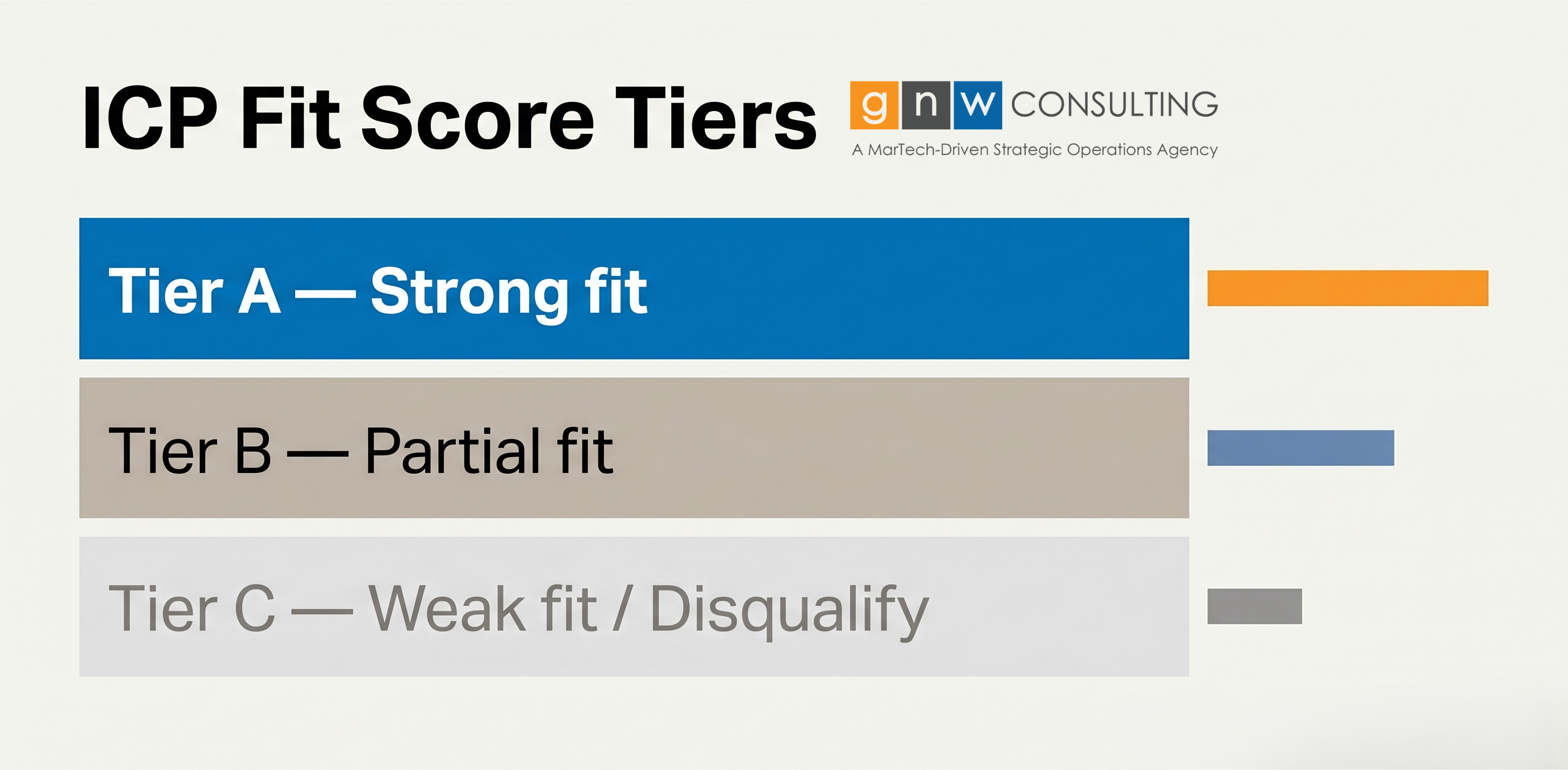
This is the foundation, and almost everything downstream keys off it. Without a scoring rubric, your sales team is back to ranking accounts by intuition, which is exactly the problem you just spent all that effort solving. With one, prioritization becomes a number instead of an argument. Tools you already own can do this. A Customer Relationship Management (CRM) system like HubSpot or Salesforce holds the outcomes, enrichment from ZoomInfo, Clearbit, or Apollo fills in firmographics and technographics, and your analytics layer supplies the behavioral signal. You don’t need a moonshot. You need your existing data pointed at the right question.
How do you use the negative ICP to disqualify deliberately?
This is the step that pays for the whole project, and it’s the one teams are weirdly reluctant to take. Naming who you will not pursue feels like leaving money on the table. It’s the opposite. Forrester’s Demand, ABM, and Customer Marketing Survey, 2024 found that 56% of opportunities handed off to sales fail to close successfully. That failure rate exists largely because fit is not a hard gate at the handoff. Every hour a rep spends on a bad-fit account is an hour pulled from a winnable one.
So make the negative ICP explicit and operational. Define your hard disqualifiers. Build suppression rules. Tell your reps, in writing, which accounts to walk away from before they sink 20 hours into a deal that was never going to close. Discipline here is not pessimism. It’s how you free up the capacity to win the deals you actually can.
How do you wire fit score into lead routing and funnel handoffs?
Now wire the fit score into the plumbing. Lead routing, account assignment, and the Marketing Qualified Lead (MQL) to Sales Qualified Lead (SQL) handoff should all be gated on fit. A high-intent lead from a low-fit account should not get the same treatment as an in-ICP account showing the same intent. Treating them identically is how you end up with the most common disease in B2B: pipeline that looks strong on the dashboard while revenue keeps missing the number.
When fit score governs the handoff, effort automatically flows toward the accounts most likely to convert. According to HubSpot’s 2026 State of Marketing report, companies that align sales and marketing around shared targeting criteria report 36% higher customer retention and significantly stronger win rates than those with disconnected definitions. Marketing stops celebrating MQLs that sales knows are garbage. Sales stops complaining about lead quality. The score becomes the referee, and the finger-pointing stops because the criteria are no longer subjective.
How do you concentrate media and ABM spend using ICP criteria?
This is where the first-party data story pays off in dollars. Build your paid audiences and lookalike models directly from your ICP criteria, and just as importantly, suppress the non-fit segments so you stop paying to reach people you’ve already decided you don’t want. Point your Account-Based Marketing (ABM) programs at the A-tier accounts and run your account-based plays against a list you can actually defend.
The leverage here is real. The same Demandbase and eMarketer 2025 research that documented 58% waste among B2B advertisers also found that reaching the right buying groups is the top challenge cited by half of all marketers. Teams that solve for this by anchoring their paid audiences to verified ICP criteria stop paying for reach and start paying for precision. Forrester’s 2024 ABM research found that ABM programs consistently yield 21% to 50% higher Return on Investment (ROI) than non-ABM marketing efforts across North American, European, and Asia Pacific markets. That result only happens when the targeting is tight. Spray-and-pray media is the single fastest way to set fire to a budget, and a sharp ICP is the fire extinguisher.
Why does personalization only work downstream of the ICP score?
Now, and only now, you personalize. This is the payoff everyone leads with, and I want you to notice it’s step five, not step one. You can’t personalize your way out of a bad target list. But once you’ve scored, disqualified, routed, and targeted, you have clean, live segments to build experiences around. Tailor your messaging, your offers, and your journeys to the segments that are converting right now, not the ones that converted last year.
The critical word there is live. Personalization built on stale segments is confident wrongness delivered with a first name attached. It only works when the segment definitions underneath it are current, which is exactly why activation and freshness matter more than the initial build. Salesforce’s 2026 State of Sales report found that top-performing sellers are 1.7 times more likely to be using AI-powered tools that deliver real-time account intelligence. The pattern is consistent: precision beats volume at every stage, and precision requires current data underneath it.
How do you align the revenue org around a shared ICP and measure it?
Finally, make the ICP the shared language of your entire revenue org. Bake one fit definition into your CRM, your dashboards, and your quarterly reviews so marketing, sales, customer success, and Revenue Operations (RevOps) all score “ideal” the same way. This is as much a governance decision as a technical one. Somebody has to own the ICP. Somebody has to have the authority to change it. Decide who, before the ambiguity decides for you.
Then measure relentlessly. Track the share of your open pipeline and your closed-won that falls inside the ICP, because in-ICP coverage is a leading indicator of pipeline quality, not just quantity. Hold the whole effort to hard numbers: Customer Acquisition Cost (CAC) reduction, win-rate lift, cycle-time compression, SQL volume, and net revenue retention on your in-ICP accounts. If the ICP isn’t moving those numbers, it isn’t working, and you’ll know fast enough to fix it.
Why is ICP activation fundamentally an integration problem?
Here’s the part that separates teams who get value from this and teams who don’t. Everything described above depends on the ICP being a data flow, not a document.
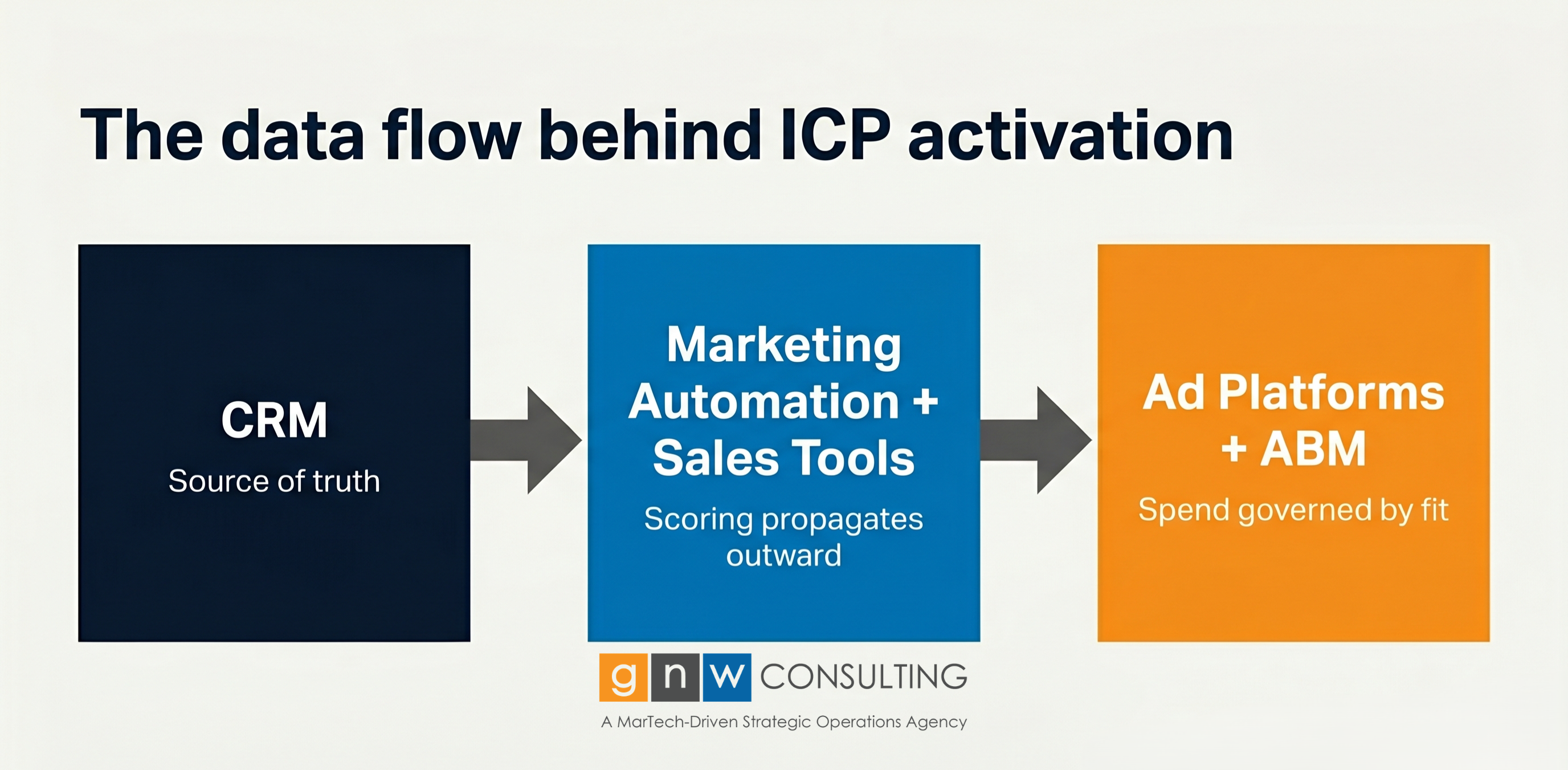
The definition has to propagate. It has to travel from your source of truth, your Customer Data Platform (CDP) or CRM, out through your connectors to every activation surface: your ad platforms, your marketing automation, your sales engagement tools. And the signals have to travel back the other way. Intent, product usage, and closed-won outcomes have to flow back into the model so the scoring stays current. That round trip, definition out and signal back, is the entire ballgame. It’s the difference between an ICP field that some analyst updates by hand twice a year and one that stays synchronized across every system that consumes it, automatically.
This is why ICP activation is fundamentally an integration problem wearing a marketing costume. The strategy is the easy part. Keeping the definition live and in sync across a real martech stack is the hard part, and it’s the part that determines whether your beautiful new ICP stays operational or quietly decays back into the academic version you started with. Get the data plumbing right and the ICP compounds in value. Get it wrong and you’ve built a very expensive slide. A GNW system audit is usually where I start with clients who have the ICP defined but aren’t sure it’s reaching their activation surfaces.
Where to start, and what to do next
If you take one thing from this: a data-sourced ICP that you don’t wire into your systems is worth almost nothing. The build is table stakes. The activation and the sync are where the revenue is.
Audit your own stack honestly. Can your ICP definition reach your ad platforms and your sales tools without somebody exporting a spreadsheet? Do your closed-won outcomes flow back to update your scoring, or does the model freeze the day you finish it? If the answer is “spreadsheet” and “freeze,” you don’t have a control layer. You have a document, and documents don’t drive pipeline.
This is the work I do at GNW Consulting through our Fractional GTM Operations practice. I help GTM teams take a data-sourced ICP off the slide and wire it into the stack so it actually governs targeting, spend, and personalization instead of sitting there looking impressive. The integration and governance layer is where most of these efforts succeed or fail, and it’s exactly where I spend my time.
If you’ve got an ICP and you’re not sure it’s doing anything operational, let’s find out together. Book a time directly on my calendar or connect with me on LinkedIn, and we’ll trace your ICP from the source of truth all the way out to activation and see where it’s breaking. Bring your stack. I’ll bring the hard questions.
Frequently Asked Questions
What is the difference between an academic ICP and an operational ICP?
An academic ICP is a profile that lives in a document or slide deck, built once and rarely updated. It describes your best thinking at a frozen moment in time but has no direct connection to the systems your teams use to make targeting, routing, or spend decisions. An operational ICP is wired into your stack as a control layer: it governs which accounts get scored, which leads get routed, which audiences receive paid media, and which segments receive personalized journeys. The academic version describes your customer. The operational version makes your entire GTM system behave accordingly.
How do you turn an ICP into a scoring rubric?
Start with your weighted ICP dimensions: firmographic (industry, company size, geography), technographic (current stack), behavioral and intent signals (hiring patterns, funding events, product usage), and your disqualifiers. Assign a point value to each dimension based on how strongly it predicts closed-won revenue in your own data. Run every account in your addressable market through the rubric to produce a fit score. Bucket the results into A (strong fit), B (partial fit), and C (weak fit or disqualify) tiers. The scoring rubric is the mechanism that converts your ICP from a description into a prioritization engine.
What systems should the ICP fit score connect to?
At minimum: your CRM (for lead routing and account assignment), your marketing automation platform (for audience segmentation and journey enrollment), your paid media platforms (for audience targeting and suppression), your sales engagement tools (for account prioritization and sequence enrollment), and your ABM platform if you run one. The fit score should propagate to every surface where a human or system makes a targeting or spend decision. If any of those systems are consuming an outdated version of the score, you have a sync problem that will quietly erode the quality of every downstream decision.
How do you keep an ICP current without rebuilding it from scratch every quarter?
Maintain a set of refresh triggers rather than a fixed calendar. The triggers that matter: win-rate compression in a previously strong segment, churn deviating from its baseline in the customer base, a pricing-mix change that shifts your addressable profile, or a category maturing in a way that changes buyer behavior. When any of those fire, pull your closed-won data and reweight the dimensions accordingly. The refresh itself, run against clean CRM data, takes roughly an hour. The mistake is treating the ICP as a permanent document. It is a hypothesis that needs to be tested against actual deal outcomes on an ongoing basis.
What metrics actually tell you whether the ICP is working operationally?
Track four things: the share of open pipeline that falls inside the ICP (in-ICP pipeline coverage), win rate on in-ICP accounts versus out-of-ICP accounts, sales cycle length by fit tier, and net revenue retention broken out by ICP fit. If in-ICP accounts are not closing faster, at higher rates, and retaining better than out-of-ICP accounts, either the ICP definition is wrong or it is not yet governing the decisions it should be. Both are fixable. What is not fixable is not measuring.
Related reading:
- Why your ICP is just a guess, and what to do about it: Part 1 of this series. How to build a data-sourced ICP from closed-won data instead of intuition.
- Request a GNW system audit: If your ICP isn’t reaching your activation surfaces, this is where we start.
Colby Renton is Vice President of GTM and AI Solutions at GNW Consulting, a certified Adobe and HubSpot partner specializing in marketing operations and revenue operations for B2B organizations. Colby helps Go-to-Market teams wire data-sourced ICPs into their martech stacks so targeting, spend, and personalization are governed by data, not intuition.
