
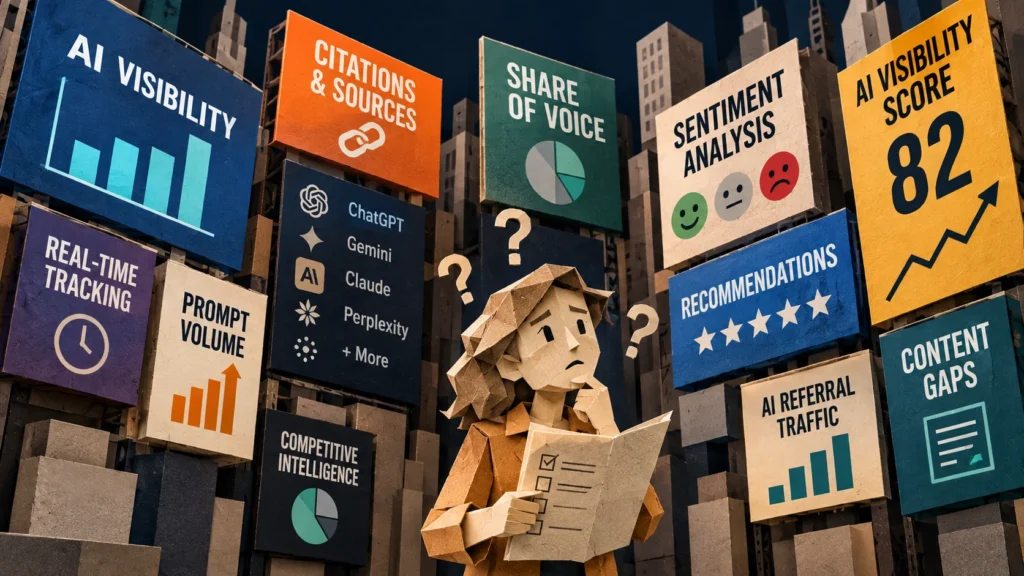
AEO tools are VERY good at telling you that something changed. And they’re considerably less good at telling you why it changed.
Said another way, they’re good at telling you what’s winning, but not actually what COULD be winning, especially in B2B.
Partner caveat: We are partners with Adobe, which means we primarily use Semrush AIO and Adobe Brand Visibility. We also have extensive experience in Profound and AirOps and some minor exposure to Rankshift, ScrunchAI, and other random platforms clients bought six months ago because someone showed their CMO a very compelling demo.
I like these tools.
I would also NEVER hand a CMO one of their dashboards and say, "Here you go. This is our GEO strategy."
So… what are these tools actually good at? Where do they fall apart? And, more importantly, what do you have to do outside the platform to turn a visibility score into revenue? That’s what this article answers.
Key Takeaways
- AEO tools (like Semrush AIO and Adobe Brand Visibility) are excellent at making AI search visibility measurable: share of voice, citation tracking, and change detection.
- They cannot explain why visibility shifted, cannot see personalized buyer sessions, and rarely connect AI mentions to actual pipeline or revenue.
- Your visibility score is only as good as the prompt set you chose to track, and most default prompt sets miss real B2B buying-stage questions.
- Mentions, recommendations, and citations are three different signals that require separate tracking and interpretation.
- The strategic layer (what to actually publish, fix, or pitch) still requires human judgment; no dashboard replaces that work.
What Do AEO Tools Actually Do Really Well?
Let’s start out with the positive, because, again, I actually really do value what these tools provide.
They make an invisible channel visible
Before I dig into this one, a few definitions are probably in order.
AEO tools as a category help quantify how a brand shows up in AI search, which matters given that less than one-third of Google searches now result in a click, pushing more discovery into AI answer surfaces. AI search is defined as prompting done within Large Language Models (LLMs) such as ChatGPT, Gemini, Perplexity, Claude and Grok. It is also the term to describe interactions between users and AI chat interfaces, like Google’s AI Overviews and AI mode.
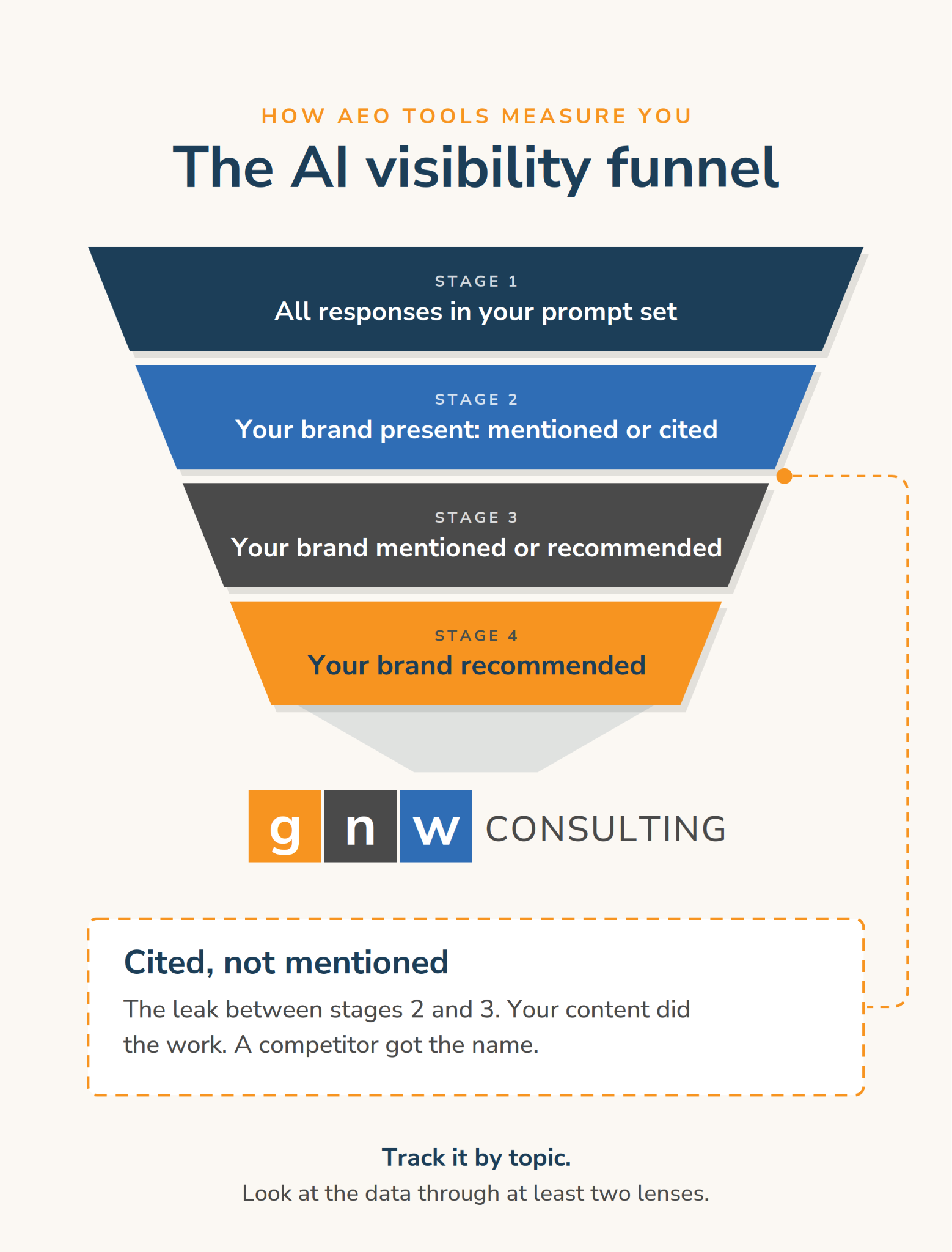
There are also a slew of new terms to help quantify which results we’re optimizing for. Namely, the number of times a brand is cited (linked as an input for the answer), mentioned (the brand is explicitly mentioned in the response) and recommended (the brand is recommended in the shortlist to the user’s prompt).
The alternative to capturing all this data through an AEO tool would be to capture it yourself in incognito windows. That would look like copy/pasting your prompts, screenshotting or copying the responses, and then probably using AI to bring it all together into rows of data that you can actually use over time and track.
A lot of people will suggest this as a first step. Those people are not me. I would NEVER suggest this. It’s a total waste of time.
If you think about how long this would take you across 100 prompts and seven engines EVERY DAY you literally would do nothing else. Meanwhile, a platform running the same prompt set repeatedly, across multiple LLMs, gives you an actual consistent baseline for around $500/month.
Competitive share of voice gives people their first "OH NO!" moment
This is one of the things these platforms do REALLY well.
In the before times, the only way most B2B brands would truly understand their share of voice would be if their PR agency pulled it from Meltwater or Cision. But AEO tools actually give a stellar picture of where you sit in the larger market in terms of share of voice.
Imagine being Anderson Windows or Pella and seeing that Gulf Coast Windows is crushing you for older home content. Yikes.

When everyone can see that some competitor half your size is being recommended all over the damn place for questions you assumed YOUR brand owned…. That tends to get people’s attention.
Fast.
And frankly, showing someone the gap is often MUCH more effective than trying to explain GEO to them with a 48-slide presentation about how large language models work.
Citation discovery might be the most valuable thing in the entire platform
I care way less about your shiny AI Visibility Score than I do about this:
What sources keep showing up when an LLM answers questions about YOUR category for YOUR buyers?
THAT is useful. And it’s probably really different than what all the LinkedIn thought leaders are telling you.
For B2B companies, you’ll usually see some combination of:
- Review sites
- Analysts
- YouTube
- Reddit/community threads
- Partner sites
- Comparison sites
- Your competitors’ websites
- And, sometimes, your own stuff (yay!)
Now you have an actual map of the information ecosystem influencing the answer.
If G2 keeps showing up… maybe you should care more about G2.
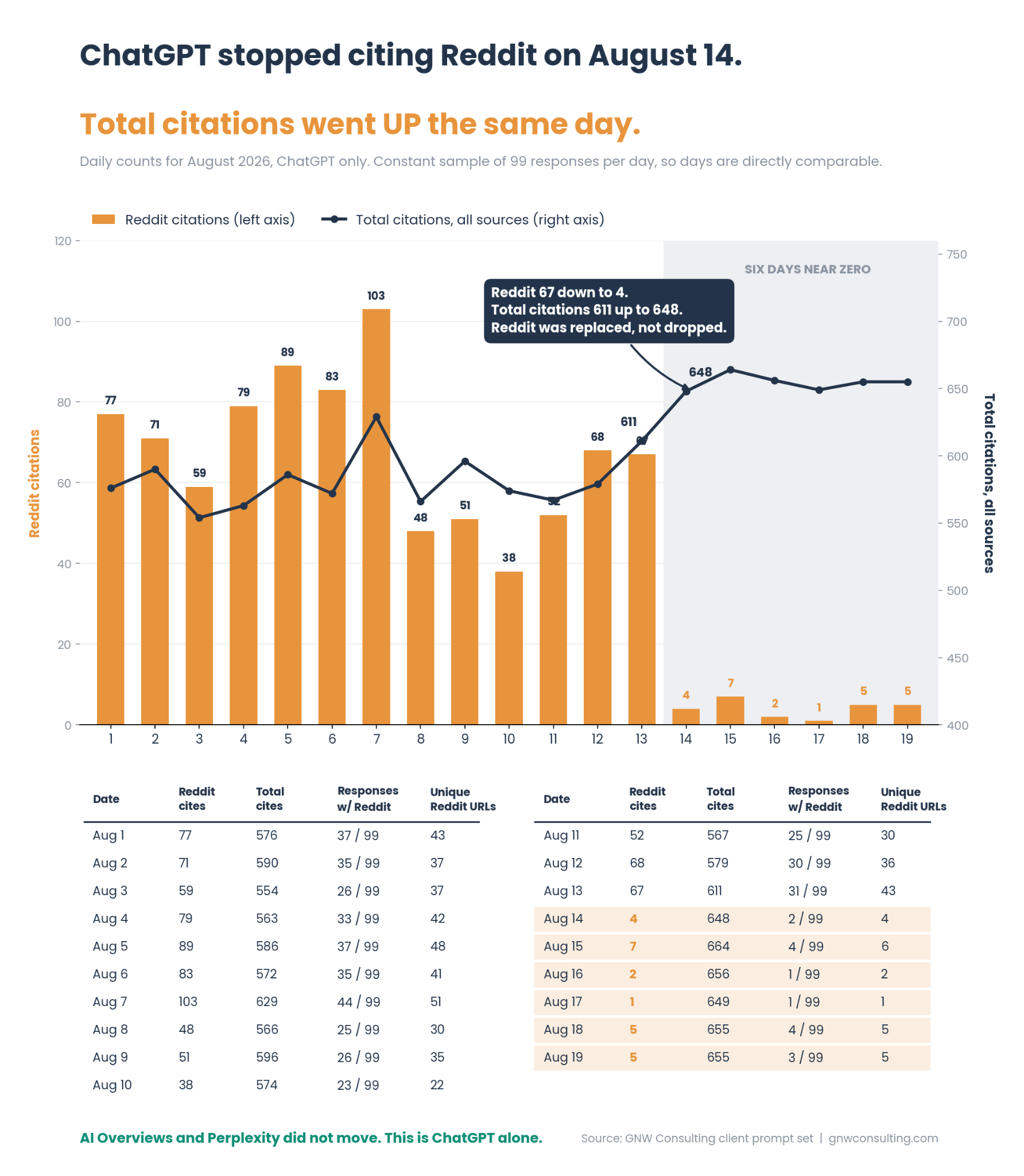
If Reddit keeps showing up… you probably need to understand the conversations happening there.
If your competitor’s "Us vs. Everybody Else" page gets cited constantly… okay, annoying, but ALSO VERY USEFUL INFORMATION.
The citations tell you where the model is learning what it thinks is true about your category.
That’s a hell of a lot more actionable than "Your visibility score is 42."
I’ll also say this on the “Should we invest in Reddit?” question – which I get ALL. THE. TIME. Every company should’ve really ALWAYS been doing SOMETHING on Reddit. Especially for the questions about, “Which tool is best for X?” You should’ve ALWAYS been in that conversation. It doesn’t take much to be there. All an AEO tool helps you do is prioritize which of those conversations are most important because they’re being cited.
Real talk: That’s just good old fashioned marketing.
They catch changes faster than humans do
The big benefit of continuously collecting answers is that weird changes become visible quickly.
If a source suddenly disappears or a competitor starts showing up everywhere or one model begins citing a site another model ignores, it’s all great data. But you NEED that baseline to even see the pattern.
Without monitoring, somebody usually discovers this because they happened to run a prompt manually… or because they saw somebody talking about it on LinkedIn three weeks later.
With monitoring, you can actually see the shift in the data.
And yes… they help get budget
Do I love that executives often require A NUMBER before they’re willing to care about something?
No.
Do I live on Earth?
Yes.
A trend line saying:
"Our presence in AI answers for these 50 buying-stage questions increased from X to Y"
is MUCH easier to take into a budget conversation than:
"I promise this ChatGPT thing is important."
The platforms turn something fuzzy into something measurable enough to manage.
That’s valuable.
Okay… now here’s where it gets messy
Because everything I just said is true.
AND…
The dashboard is still not a strategy.
Your prompt set is a hypothesis pretending to be a dataset
This is probably my biggest issue with AI visibility reporting.
Your entire visibility score is based on the PROMPTS YOU DECIDED TO TRACK.
Read that again.
We don’t have Google Search Console for ChatGPT.
We do not get a lovely little export containing every question buyers asked before they found your company.
We have a sample. And YOU chose the sample.
Or, worse, your software vendor auto-generated it for you.
Which means you can have a beautifully calculated, statistically impressive-looking visibility score built on… a mediocre list of questions nobody actually asks.
This matters A LOT in B2B.
Because B2B buyers are not only asking:
Best CRM software
They’re asking:
What’s a CRM for a 400-person fintech company using Salesforce that needs SOC 2 compliance, integrates with Snowflake and doesn’t require six months of implementation?
THAT is what real conversational search looks like.
And if your tracked prompt set is 50 cute little two-sentence SEO keywords wearing fake mustaches…
Your visibility number is BS.
Prompt volume does not magically solve this
This is another thing I would be VERY careful with.
A lot of GEO vendors now offer estimated "prompt volume," which makes everyone immediately want to treat it like keyword search volume.
"Great! We’ll just prioritize the highest-volume prompts!"
Mmmmmmmmm.
Maybe.
Prompt-volume estimates can absolutely be useful as a directional prioritization signal.
But the data is modeled. The underlying datasets vary. Prompt normalization varies. And conversational queries are MUCH messier than traditional keywords.
Especially in niche B2B markets, I would rather track a lower-volume question that maps directly to an expensive buying decision than chase some giant informational prompt because the dashboard says 18,000 people ask it.
Volume is a signal.
It is NOT God.
If you want to learn more about this, I go deep here: https://www.linkedin.com/pulse/can-we-trust-ai-prompt-volume-gnw-consulting-nm6bc/
The tool is not seeing what your buyer sees
This one gets REALLY interesting.
Most monitoring tools need some kind of standardized querying environment. That’s good! You need consistency to measure anything.
But your actual buyer does not live in that standardized environment.
They may be logged into ChatGPT.
They may have memory enabled.
They may have spent the last three weeks asking questions about their tech stack, budget, company size and industry.
They may be using Microsoft Copilot inside their company.
They may be using an enterprise LLM connected to internal documents.
Which means the tool is measuring:
What does a relatively generic model response look like?
Your buyer may be receiving:
What does the model recommend given EVERYTHING IT ALREADY KNOWS ABOUT ME?
Those are not necessarily the same answer.
And you HAVE to separate mentions, recommendations and citations
This is a place where I think marketers get themselves into trouble FAST.
These are not the same thing:
Mention: Your brand appears somewhere in the answer.
Recommendation: The model actually suggests your company/product as something the user should consider.
Citation: Your website (or content about you) appears as a source.
Those three things can overlap.
But they don’t always.
And sometimes you get the especially weird scenario where your website is CITED as a source… while the model recommends somebody else.
Which is why "we appeared in 43% of responses" doesn’t tell me nearly enough, nor does it provide with what to DO about it.
They have basically ZERO idea what happened to pipeline
As is usual with any top of funnel tool, these tools have no integration with marketing automation or CRM down funnel. And that’s especially painful for B2B marketers with 9 month sales cycles.
The AEO platform knows you got mentioned.
Cool.
Did anyone click?
Most have a Google Analytics and Bing integration to capture AI-Assistant traffic referrals. Cool.
Did they come back later through Google?
Did they type your URL directly?
Did they book a demo?
Did they become an opportunity?
Did that opportunity close?
The AEO tool has no fucking clue on that last group.
And this is the part that matters if you’re eventually going to sit in front of a CFO.
Your CMO might care that AI share of voice improved.
Your CFO would probably like to know whether we sold anything.
So you still have to do the boring grown-up marketing operations work:
- Track AI referrals
- Add AI engines to self-reported attribution
- Connect activity back to leads/accounts
- Create Salesforce campaigns with the right campaign type and member statuses and make sure people are in there
- Measure opportunity creation (automate contact role association)
- Measure pipeline
- Measure bookings
- Measure revenue
This is why I keep yelling that GEO is NOT JUST SEO WITH A CHATGPT HAT ON.
Eventually this work has to touch the rest of your revenue infrastructure. Those ARE the metrics that this work can and should be measured against.
The recommendations are usually generic as hell
This is where most AEO tools become SEO tools wearing slightly different pants.
"Create comparison content."
"Add FAQ schema."
"Improve topical authority."
"Increase brand mentions."
Okay.
Thanks.
Very insightful.
The tool does not know that your company’s strongest differentiator is implementation speed.
It doesn’t know your sales team loses deals because buyers think your product only works for enterprise companies.
It doesn’t know that ONE analyst report is disproportionately influencing your category and getting in front of that analyst is going to take a miracle.
It doesn’t know that YouTube isn’t showing up because no one is answering the buyers’ questions in YouTube but if someone DID it would crush.
And it definitely doesn’t know the internal political nightmare involved in getting Legal to approve that new comparison page.
That’s the strategic layer.
And I have yet to meet a dashboard that can do that part for you.
So… how SHOULD you use AEO tools?
Keep the tool. Buy the tool.
Seriously.
But be smart about how you use it and what you expect.
Here’s how we use these platforms in actual client work.
1. Build prompts around actual buyer questions
Use:
- Sales calls
- RFPs
- Win/loss interviews
- Support tickets
- Community questions
- Search data
- SemRush’s prompt data
- Existing customer language
- Sales-team FAQs
Then layer in the questions people WOULD plausibly ask an LLM because conversational search allows them to be more specific.
Your prompts should reflect buying situations.
Not just keywords.
2. Track topics… not just one giant visibility score
Your aggregate visibility number can hide all kinds of useful information.
Maybe you’re GREAT on beginner educational questions.
And basically invisible on the questions somebody asks three days before buying.
Those are very different situations.
We generally want to know visibility by topic and intent so we can understand WHERE the problem actually exists.
3. Look at trends… not screenshots
One answer is an anecdote.
One week can be noise.
Look for consistent movement across enough prompts and enough time to convince yourself something actually changed.
4. READ THE DAMN ANSWERS
This sounds obvious, but I’m surprised how often people miss it: The dashboard tells you whether you appeared, but the actual response tells you what the model THINKS ABOUT YOU.
Those are different questions.
You can have fantastic visibility and TERRIBLE positioning. Some tools do this in sentiment, but even that can’t always align to what you WANT the model saying. It might be saying nice things, but inaccurate things none-the-less.
If ChatGPT recommends your product but describes you as "best suited for small businesses" when you’re desperately trying to move upmarket… then it’s good, but not great.
Read the answers.
Especially for the prompts closest to a buying decision.
5. Treat citation data like a distribution roadmap
This is one of my favorite uses of these tools.
Look at the domains influencing your category.
Then ask:
Can we realistically show up there?
Maybe that’s:
- Analyst relations
- Review programs
- PR
- Partner content
- Reddit participation
- YouTube
- Industry publications
- Expert roundups
- Third-party comparisons
Because here’s the annoying thing marketers keep having to relearn:
You do not control the internet.
And neither does your website.
A LOT of what determines how an LLM understands your brand happens somewhere other than your domain.
6. Connect the whole thing to your actual revenue stack
GA4.
HubSpot.
Marketo.
Salesforce.
Whatever you’ve got.
At minimum, track AI referral traffic and add AI discovery to your self-reported attribution.
And then start looking at what happens AFTER the click.
Because "ChatGPT sent us 900 sessions" is neat.
"ChatGPT influenced $1.4M in pipeline" is a different conversation.
Although, honestly, you SHOULD start hearing from your sales reps, “These ChatGPT leads are awesome.” It’s what every one of our clients’ reps say.
7. SHIP SOME SHIT… for the love of all that you hold dear
This is maybe the least sophisticated advice in this entire article.
It is also some of the most important.
Publish the page.
Update the comparison.
Pitch the analyst.
Fix the positioning.
Answer the Reddit question.
Make the YouTube video.
Get MORE useful information about your company into the information ecosystem.
Then watch what changes.
Because the tool’s best role is not:
Tell me exactly what to do.
Its best role is:
Help me see whether the stuff we did appears to be changing the answers.
THAT is a feedback loop.
And feedback loops are useful.
The bottom line
I think AEO tools are valuable.
We pay for them (more than one actually).
We use them constantly.
I also think marketers are giving these dashboards WAY too much authority.
They are measurement systems built around a sampled set of prompts in a probabilistic environment where nobody — including the vendors — has complete visibility into actual user behavior.
Which means the goal is not to worship the score.
The goal is to use the tool to figure out:
Where are we visible?
Where are we NOT visible?
How are we being described?
Who is beating us?
What sources appear to be influencing the answer?
What can we change?
And then…
GO CHANGE IT.
That’s the work.
The software just helps you see it.
If you want help with THAT part, that’s what we do at GNW Consulting. We run the tools, build the measurement strategy, figure out what the data actually means and then do the hands-on work required to move it.
And if you’d rather DIY it… honestly, excellent.
Grab our free GEO skill library on GitHub.
Go break some stuff.
Frequently Asked Questions
What is an AEO tool? An AEO (Answer Engine Optimization) tool is a platform, such as Semrush AIO or Adobe Brand Visibility, that monitors how a brand appears in AI search responses across engines like ChatGPT, Perplexity, and Google AI Overviews. It tracks metrics like share of voice, citation frequency, and recommendation rate across a defined set of prompts.
Can AEO tools tell me why my AI visibility changed? No. AEO tools reliably show that a change happened, such as a competitor gaining share of voice or a source disappearing from citations, but they cannot explain the underlying cause. Diagnosing the why requires human analysis of the citation sources, buyer language, and competitive positioning behind the shift.
Do AEO tools track pipeline and revenue? Most do not. AEO platforms typically integrate with Google Analytics or Bing for referral traffic but have no native connection to CRM or marketing automation systems. Connecting AI visibility to pipeline requires manually linking AI referral data to Salesforce, HubSpot, or Marketo campaigns and opportunity records.
Should B2B marketers build their own prompt sets instead of using vendor defaults? Yes. Vendor-generated prompt sets often default to generic, short-tail queries that don’t reflect how B2B buyers actually search. Building prompts from sales calls, RFPs, win/loss interviews, and support tickets produces a far more accurate picture of real buying-stage visibility.
What’s the difference between a mention, a recommendation, and a citation in AI search? A mention means a brand appears somewhere in an AI-generated answer. A recommendation means the model actively suggests the brand as a solution. A citation means the brand’s website or content is listed as a source. These three outcomes often diverge, so tracking them separately gives a clearer read on actual AI search performance.
