

Tying marketing campaigns directly to revenue is one of the most consistently elusive goals in B2B marketing. According to RevSure’s 2025 State of B2B Marketing Attribution report, only 21% of B2B marketers are confident in their attribution data, and only 18.2% use integrated attribution across channels. The Content Marketing Institute’s B2B Content Marketing Trends 2026 research found that 56% of B2B marketers struggle to attribute return on investment (ROI) to marketing efforts and 56% struggle to track the full customer journey. Achieving accurate ROI reporting in Salesforce requires very simple relationships between different tables. Although essentially straightforward, this is an issue that has remained foggy for decades. This guide clears the fog.
Key Takeaways
- Accurate marketing ROI reporting in Salesforce requires six foundational elements: opportunity field data, opportunity contact roles, primary campaign source, campaign influence logic, campaign member statuses, and campaign cost data.
- Only 21% of B2B marketers are confident in their attribution data, per RevSure’s 2025 research. The root cause is almost always missing or inconsistent data at the configuration level, not a platform limitation.
- Opportunity contact roles are the most commonly neglected element: most organizations have the majority of opportunities with no contacts associated, making it impossible to connect marketing activity to deals.
- Campaign influence logic is more accurate than the primary campaign source field for complex B2B sales cycles. CaliberMind’s 2025 State of Marketing Attribution report found that 60% of organizations abandon multi-touch attribution within six months, almost always due to configuration problems, not platform limitations.
- Campaign member statuses must be consistent across campaign types. Small inconsistencies compound over time and corrupt influence reporting.
- Missing campaign cost data makes ROI calculation impossible. Without the investment figure, there is no return to calculate.
What does accurate ROI reporting in Salesforce actually require?
To tie marketing campaigns to revenue and produce accurate ROI reporting, you need certain foundational elements in place within Salesforce. These include:
- Opportunity field data: date, stage, amount
- Opportunity contact roles (connects people to opportunities)
- Opportunity primary campaign source field (connects a campaign to an opportunity)
- Campaign members and campaign influence (connects people to campaigns)
- Campaign member statuses (determines successful interaction with the campaign)
- Campaign data: dates and investment
- Person field data: Lead Source, Lead Source Detail, and other key fields (not a requirement, but a best practice)
According to Salesforce’s 2026 Tenth Edition State of Marketing report, based on 4,450 marketing decision makers worldwide, only 56% of marketers have complete access to sales data and only 58% have complete access to service data. Siloed systems are the top barrier cited. That is the organizational context in which most Salesforce ROI reporting problems exist.
Bonus: Salesforce campaign to Marketo program sync
The sync between Marketo programs and Salesforce campaigns is the best in the business. Not even Pardot (Account Engagement), which is native to Salesforce, is better. This isn’t the point of this article, but see our infographic on best practices for syncing Marketo programs and Salesforce campaigns to understand why it’s so great.
What opportunity field data do you need for ROI reporting?
Why is it important?
This list includes the values that are universally important, but will not be exhaustive to your reporting needs. When thinking about required fields, consider how marketing and other departments will want to segment or group data in reports.
Common challenges with opportunity fields
Amount: Many companies house multiple amount fields on the opportunity. One field might have software costs, another service costs. One might be a monthly recurring revenue roll-up, while another is annual. Make sure the standard out-of-the-box "Amount" field is the value you actually want to report on. This is the field that syncs to most systems, namely marketing automation.
Stage: Understand which stages are actually incorporated into pipeline, as many companies create an opportunity but do not consider it "pipeline" until a specific stage. Also note that changing stage names adjusts time calculations in Salesforce, so only edit them after thorough consideration.
Best practice
It can be tempting to write a lot of data directly on the opportunity object, but remember that sales reps should be mostly selling, not inputting data. Be really critical when adding another required field to the process.
Why are opportunity contact roles essential for marketing attribution?
Why are they important?
Opportunity contact roles build a relationship between individuals and their role in a deal. Roles are customizable, but common values are influencer, decision maker, procurement, and finance. This provides essential visibility into how specific people are involved in a deal and allows for more seamless collaboration. For example, if you want your Chief Executive Officer (CEO) to connect with executives when a deal moves to a late stage like "Contract Review," creating the contact role relationship allows that motion to be automated.

Common challenges with opportunity contact roles
- Building contact roles is typically left to sales reps who do not prioritize the behavior or are unaware the relationship exists and why it matters. The result: the majority of opportunities have no contacts associated.
- Opportunity creation is restricted to contact creation, meaning only the original contact from which the opportunity was created is associated.
Impact of incomplete or inaccurate contact roles
- Inefficient deal management
- Stifled collaboration within sales teams
- Stifled collaboration between sales and cross-functional teams (finance, executives, marketing)
- Misrepresentation of marketing’s contribution to revenue
Solution options for improving opportunity contact roles
Fear not, there are a variety of solutions, some easy, some more complex. If you’d like help working through them, contact GNW for an assessment of what’s right for you.
Keep doing what you’re doing with improved training and enablement. Biggest risk: behavior may not change significantly, leading to continued data inaccuracies.
Only allow opportunity creation from a contact record. Biggest risk: opportunity creation may be delayed as reps have to ensure a contact is linked before they can proceed.
Implement stage-based validation rules. Example: to move to "Contract" stage, an opportunity must have "Financial DM" and "Power User" contact roles assigned. Biggest risk: frustration from sales reps when forced to adhere to strict rules, especially in fast-moving deals.
Automate contact role association based on defined rules. Example: anyone on the account where "finance" is found in the job title is associated via a "Finance Influencer" contact role. Biggest risk: automated rules may miss key influencers or not keep up with changes in account structures.
How should you use the opportunity primary campaign source field?
Why is it important?
The "Primary Campaign Source" field is used to directly connect opportunities to a specific marketing campaign. As its name indicates, most organizations prefer it to represent the campaign that had the most impact on the deal.
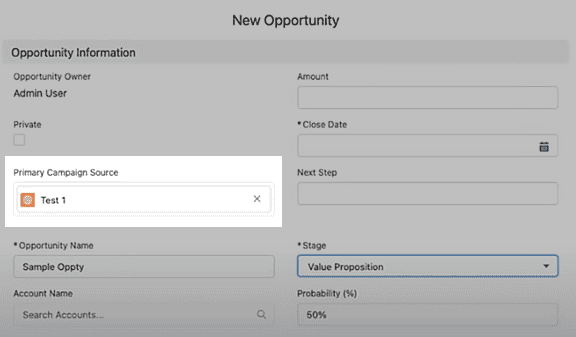
Common challenges with primary campaign source
- How can one truly associate a single marketing initiative as the most impactful for long, complex B2B buying journeys? This is often a point of considerable contention when looking at primary campaign data. With that said, it is directionally helpful information for most organizations trying to go from no data to something.
- Sales reps are often responsible for selecting the campaign they believe had the biggest impact, leading to low confidence that the most relevant campaign was selected and causing underrepresentation of more effective marketing efforts.
- It is common for the last campaign associated with the contact where the opportunity started from to automatically populate in the primary campaign field. Issues with timeliness of campaign membership are often problematic in this situation.
Impact of inaccurate or inconsistent primary campaign selection
- Poor budget allocation due to inaccurate representation of marketing’s contribution
- Misleading ROI reports
Solution options for primary campaign source
Keep doing what you’re doing with improved training and enablement. Biggest risk: behavior unlikely to change, leaving data inaccuracies in place.
Stop using the primary campaign field entirely and focus on campaign influence. Biggest risk: resetting reporting expectations and adjusting focus to multi-touch attribution models rather than single-campaign attribution. The story of "what’s working" becomes more complex, albeit more accurate.
Automate the association of the primary campaign. Biggest risk: automated rules may struggle to identify the most impactful campaign.
Create a marketing-led process for manual population. Biggest risk: time-consuming and requires dedicated marketing oversight. It also scales horribly, but for teams with under ten opportunities closed per month, this often makes the most sense.
What is campaign influence and why does it matter?
Why is it important?
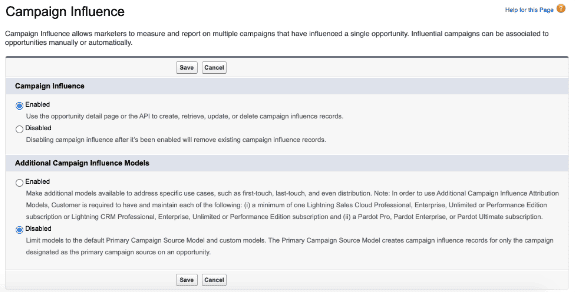
Campaign influence logic allows you to create many-to-many relationships between people, campaigns, and opportunities. It is a more advanced approach to understanding how multiple marketing initiatives across buying committee members impact a deal, especially over lengthy sales cycles.
CaliberMind’s 2025 State of Marketing Attribution report found that multi-touch attribution (MTA) adoption reached 47% of organizations, up from 31% in 2023, but only 18% of those implementations were rated as highly accurate by their own teams, and 60% abandoned MTA within six months. The failure mode is almost always at the configuration layer.
Common challenges with campaign influence
- It is simply not turned on.
- Models are not created.
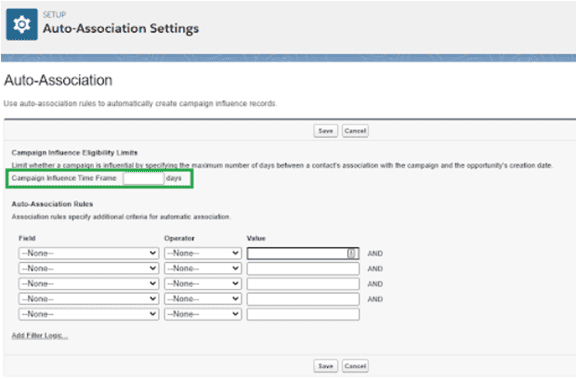
- Timeframe is too long and not agreed upon.
- Missing campaign membership due to delayed association. This is very common in events where sellers create an opportunity in real time at the event, but the events team does not associate people to the event campaign until after the event.
Impact of missing campaign influence logic
- Incomplete understanding of marketing’s true impact on revenue
- Missed opportunities to optimize campaigns that are contributing to deals
Implementing campaign influence models
Salesforce offers flexibility in building custom campaign influence models. Start by implementing these common models:
First touch: attributes revenue to the first marketing interaction. Last touch: attributes revenue to the last marketing touchpoint before an opportunity is created. Even distribution: distributes revenue evenly across all influencing campaigns.
Best practices for campaign influence
- Require "Responded = True" for campaign member statuses included in campaign influence. This means someone responded positively to a marketing initiative, not just that marketing attempted to communicate with them.
- Align campaign influence timeframes with your sales cycle. If you are unsure what timeframe is right, choose one, pull a report, see if the data makes sense, then adjust and compare. In general, being more conservative with shorter timeframes works better than longer ones, where more campaigns will be included, making sales skeptical and muddying your data. The more campaigns included, the less revenue each campaign receives, so accuracy matters more than volume.
- Review and update your campaign influence rules regularly as your sales cycle evolves and marketing strategies change.
Why do campaign member statuses affect attribution accuracy?
Why are they important?
Campaign member statuses determine whether a contact has successfully engaged with a campaign, which is crucial for influence reporting. For example, the statuses for a webinar might be Sent, Registered, Attended, and No Show, with "Responded = True" for Registered, Attended, and No Show.

Common challenges with campaign member statuses
- Inconsistency is the biggest issue. Small differences like "attend" versus "attended" can cause significant problems. Ensure all statuses are consistent across campaign types.
- Erroneous "Responded" flags. A common criterion for including campaign members in influence reporting is the "Responded" qualification. That means the responded flag needs to be accurately set and consistent.
Impact of inconsistent or missing member statuses
- Inflated campaign engagement
- Reduced ability to attribute revenue to specific campaigns accurately
Best practices for campaign member statuses
- Remain consistent and do not make changes unless absolutely necessary. It is painful to retroactively align everything. If you are only slightly annoyed that it says "attend" when you are used to "attended," let it go.
- Use clear and standardized member statuses across campaigns to ensure consistency in reporting.
- Document what you use and why so new team members can learn and adhere to what has been set.
Why does missing campaign cost data make ROI reporting impossible?
Why is it important?
Dates are essential for determining the timeframe of reports, while investment data is necessary to calculate ROI. Without the "I" (investment), there is no way to determine the return.

Common current states GNW sees
- Campaign investment data (budget and actual spend) is often missing entirely.
- Investment data is also commonly entered incorrectly.
- Large swings in campaign costs, for example $1 in email sends versus $500,000 for a trade show, make quick insights from visual reports very challenging.
- Erroneous end dates exclude campaigns that extend over quarters from time-based reports.
Impact of missing campaign data
- Reporting by specific timeframes excludes campaigns
- Manual calculations required to assess ROI, increasing the risk of errors
Best practices for campaign data entry
- Ensure campaign start and end dates are diligently entered into Salesforce.
- Always input both budgeted and actual campaign costs. To avoid visibility concerns, adjust permissions to ensure only marketing staff can access this data.
Frequently Asked Questions
What is the difference between primary campaign source and campaign influence in Salesforce?
Primary campaign source is a single-value field on the opportunity that connects one campaign to one deal. Campaign influence is a many-to-many model that connects multiple campaigns across multiple contacts to a single opportunity, based on engagement within a defined timeframe. For complex B2B sales cycles, campaign influence is the more accurate model. Primary campaign source is useful as a directional signal but should not be the sole basis for attribution decisions.
Why do most Salesforce ROI reporting setups fail?
The most common failure points are incomplete opportunity contact roles, inconsistent campaign member statuses, missing campaign cost data, and campaign influence timeframes that are either too broad or never configured. These are data governance and configuration problems, not platform limitations. They require cross-functional alignment between marketing, sales, and revenue operations to resolve.
How do you decide which campaign influence model to use?
The right model depends on your sales cycle and what behavior you want to incentivize. First touch rewards campaigns that generate initial awareness. Last touch rewards campaigns that accelerate deals to creation. Even distribution is the most neutral model and works well when you want to understand the full breadth of marketing’s contribution. Most organizations benefit from running multiple models simultaneously and comparing outputs rather than committing to one as the definitive truth.
How do you get sales reps to fill in contact roles consistently?
Training alone rarely changes behavior. The most effective approaches are structural: automating contact role association where possible, implementing stage-based validation rules that require key contact roles before deal advancement, and creating a clear documented standard for what data is required at each stage. GNW recommends starting with an assessment of your current contact role completion rate before choosing an enforcement approach.
What is multi-touch attribution and why do so many organizations abandon it?
Multi-touch attribution (MTA) models distribute revenue credit across multiple campaigns and touchpoints rather than attributing a deal to a single campaign. CaliberMind’s 2025 State of Marketing Attribution report found that 60% of organizations abandon MTA within six months. The reason is almost always configuration: influence timeframes that are too broad, campaign member statuses that are inconsistently set, or models that were never aligned with the actual sales cycle. The fix is almost never to abandon MTA. It is to fix the foundational data issues first.
GNW Consulting is a certified Salesforce and Adobe partner specializing in marketing operations and revenue operations for B2B organizations. For questions about Salesforce ROI reporting setup, campaign influence configuration, or attribution strategy, contact our team or explore our marketing operations services.
