


What is driving the move to data-sourced ICPs?
So why is everyone suddenly racing to rebuild the ICP from data instead of intuition? It’s not a trend. It’s a pile-up of four separate pressures hitting at the same time, and personalization, the reason most people give, is honestly the least interesting one.
Why B2B marketing spend keeps missing revenue targets — and why efficient targeting is no longer optional
According to Forrester’s B2B Marketing Budget Benchmarks, the average B2B firm invests 8% of annual revenue in marketing, and Gartner’s 2025 CMO Spend Survey puts that number at 7.7%. For a company doing $50M in revenue, that’s roughly $4M in marketing spend alone, before you add sales headcount, tools, and agency fees. Over half of that combined budget is landing on accounts that will never buy.
When the majority of that spend is chasing the wrong accounts, the math gets ugly fast. HubSpot’s 2026 State of Marketing data shows the average conversion rate sits at 13–21%, meaning nearly 80% of the leads you paid to generate never turn into a dollar. You’re not buying customers with that spend. You’re buying motion.
A data-sourced ICP is the cheapest fix available because it attacks the leak at the source. When you build your profile from your actual closed-won data instead of your assumptions, the downstream effects are immediate and measurable. Teams report higher win rates, lower cost per lead, faster sales cycles, and more predictable pipeline. The revenue impact shows up in the same data: Salesforce’s 2024 State of Sales report found that sales teams anchoring their targeting to data-driven customer profiles are 1.3x more likely to see revenue growth than those relying on intuition alone. That’s a Chief Financial Officer (CFO) win, and in this budget environment, the CFO is the one you have to convince.
Why the death of third-party cookies makes first-party ICP data non-negotiable
Third-party cookies are degrading. Privacy regulation is tightening on a state-by-state, country-by-country basis. The walled gardens are getting taller. The era of renting a customer profile off a data broker’s shelf is ending, and marketers know it. Salesforce’s 2026 State of Marketing report found that 84% of marketing teams have already made the shift to first-party data, a clear signal that the industry has moved toward owning its own signals. The same research cites siloed data and poor targeting infrastructure as the primary barriers stopping that first-party data from actually improving campaign outcomes.
Here’s the connection people miss: a data-sourced ICP is literally how you operationalize first-party data. It’s the mechanism. You’re mining your own Customer Relationship Management (CRM) system, your own product usage, your own behavioral signals, your own receipts, to define who “ideal” actually is. The privacy changes didn’t just take away your old toys. They pushed you toward a better one, whether you meant to pick it up or not.
Why sales and marketing misalignment starts with a poorly defined ICP
This is the one nobody puts on a slide, and it’s the one that does the most quiet damage. When the ICP lives in intuition, every team optimizes its own version. Marketing tunes its definition around what generates leads in LinkedIn, while sales is thinking about what makes a clean opportunity in ZoomInfo, and before long the two teams are speaking different dialects of the same word. “Ideal” means one thing in a campaign brief and a completely different thing on the sales floor.
A shared, data-driven definition fixes this because there’s nothing left to argue about. The data says who converts, expands, and renews, and everyone scores against the same rubric. The smarter vendors have started calling ICP segments the new go-to-market revenue infrastructure, the foundation that unifies marketing, sales, and customer success. That’s a little grand for my taste, but the underlying point is right. The ICP stops being a marketing artifact and becomes the connective tissue of the whole revenue org.
How AI turned the ICP from a static profile into a predictive revenue tool
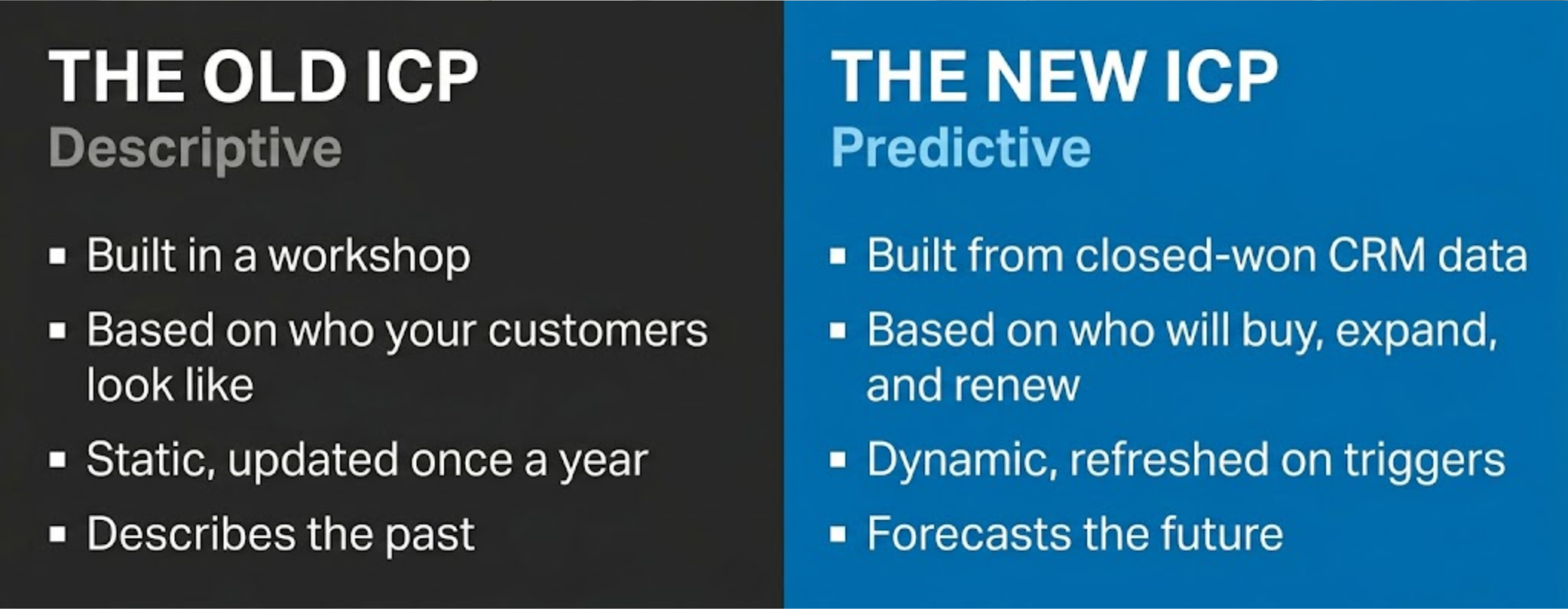
For most of my 25 years in this business, the data-driven ICP was a good idea that died in execution. The math was too much to do by hand, and the data lived in twelve systems that didn’t talk to each other. That constraint is gone. Modern Customer Data Platforms (CDPs) use machine learning to consolidate signals from every touchpoint into a single profile and forecast behavior like purchase timing and churn risk. Salesforce’s 2024 State of Sales report, based on 5,500 sales professionals surveyed across four regions, found that sales teams using AI are 1.3x more likely to outperform peers who don’t. Broader adoption data backs this up: Adobe’s 2026 AI and Digital Trends report, based on surveys of 3,000 executives and 4,000 customers, found that 65% of organizations report marketing-driven revenue growth directly attributable to AI adoption.
This is the real unlock. AI moves the ICP from descriptive to predictive. The old ICP described who looked like your customers. The new one predicts who will buy, expand, and renew before they’ve raised a hand. That’s a different species of tool.
And yes, personalization. It’s real, it matters, and it’s the most visible payoff because it’s the part the customer actually feels. But notice that personalization sits downstream of all four forces above. You can’t personalize your way out of a bad target list. Personalization is what a good ICP lets you do. It is not the reason to build one.
What do you actually need to do to fix your ICP?
Enough diagnosis. Here is the work.
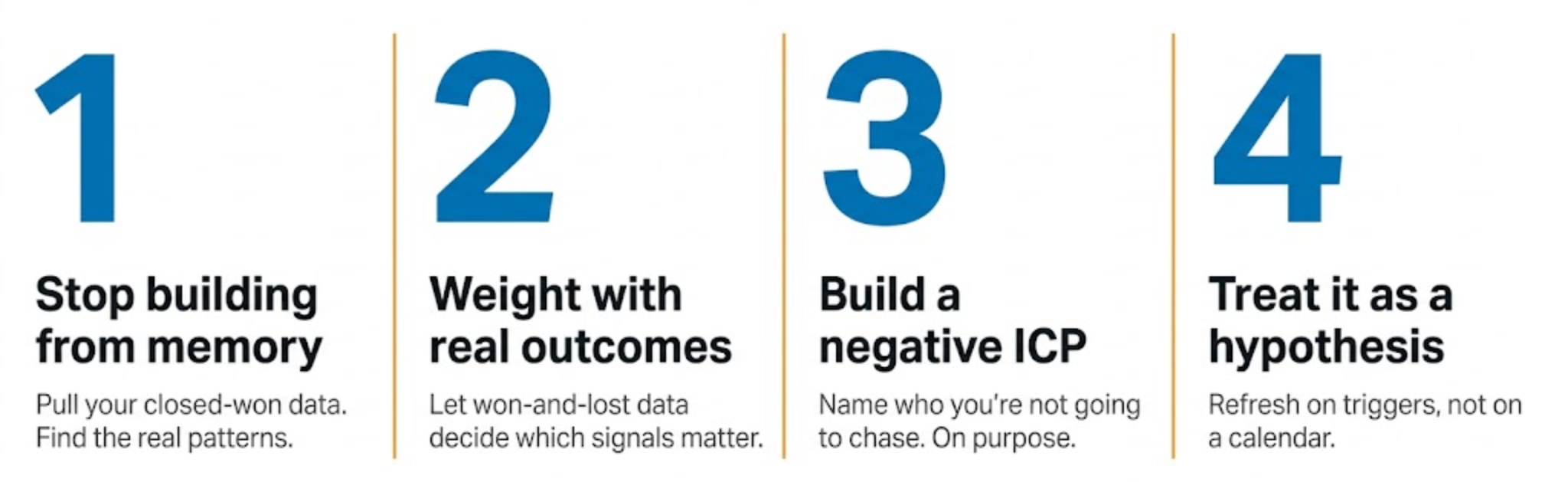
Stop building your ICP from memory
If your current profile came out of a workshop and not a query, it’s a hypothesis at best and a liability at worst. Go pull your closed-won data. Look at your most profitable, fastest-closing, longest-retaining customers and find the patterns that are actually there, not the ones you wish were there.
Weight it with real outcomes
Firmographics (industry, size) are only one layer. Layer in technographics (their stack), behavioral and intent signals (hiring, funding, product usage), and organizational readiness. Then let your won-and-lost data tell you which of those dimensions actually predict revenue, and weight accordingly. The point is to replace opinion with evidence.
Build a negative ICP, on purpose
This is the half everyone skips, and it’s where a shocking amount of the savings live. Name the accounts you are going to stop chasing. Define your disqualifiers as clearly as your qualifiers. Every hour a rep spends on a bad-fit account is an hour stolen from a good one.
Treat it as a living hypothesis, not a monument
Markets shift constantly. Your best segment six months ago may be compressing right now. Refresh on triggers: win-rate compression in a previously strong segment, churn deviating from its baseline, a pricing-mix change, a category maturing. A disciplined refresh against clean CRM data takes about an hour. There is no excuse for running on a profile that went stale two quarters ago.
The bottom line, and what to do next
The companies pulling away from the pack right now are not the ones with the biggest budgets or the cleverest campaigns. They’re the ones who know exactly who they’re selling to and have the data to prove it. Everyone else is spending real money to reach people who were never going to buy, then blaming the campaign when the pipeline misses.
If you’re still running on a gut-feel ICP, you’re not behind because you lack tools. You’re behind because you’re guessing, and your competitors stopped guessing. The good news is that this is one of the highest-leverage, lowest-cost fixes available to you, and the raw material is already sitting in your CRM.
That’s the work I do. At GNW Consulting, I help Go-to-Market (GTM) teams turn vague “ideal customer” hand-waving into a data-sourced profile that actually drives targeting, spend, and revenue, and I do it without the six-month transformation theater. If your pipeline looks strong but your revenue keeps missing, your ICP is usually the first place I look, and it’s usually the problem.
So here’s my ask. Go look at your current ICP. If you can’t tell me which dataset it came from, we should talk. Book a time directly on my calendar or find me on LinkedIn, and let’s pressure-test who you think your best customer is against who your data says it is. I’ll tell you straight whether you have an ICP or just a really confident guess.
Frequently Asked Questions
What is an Ideal Customer Profile (ICP)?
An Ideal Customer Profile is a detailed description of the company most likely to buy your product, achieve full value from it, retain long-term, and refer others. A complete ICP combines firmographics (industry, size, geography), technographics (current tech stack), behavioral signals (hiring, funding, product usage), and organizational readiness. In 2026, the most effective ICPs are built from closed-won data in your CRM, not from workshop opinions.
How is a data-sourced ICP different from a traditional ICP?
A traditional ICP is built from intuition: a workshop, a whiteboard, a few smart people deciding who their “best” customers look like. A data-sourced ICP is built from your actual closed-won data, layered with behavioral and intent signals, and weighted by the dimensions that statistically predict revenue. The traditional version describes who you think your customers are. The data-sourced version describes who they actually are.
What is a negative ICP and why does it matter?
A negative ICP is the explicit definition of accounts you are not going to chase. It names your disqualifiers as clearly as your qualifiers: industries you don’t serve well, company sizes that don’t fit your pricing, technographic mismatches, and any other signal that predicts a bad fit. Building one matters because the cost of chasing bad-fit accounts is measured in rep hours pulled away from deals that can actually close. Most of the savings in ICP work come from the negative half.
How often should I refresh my ICP?
Refresh on triggers, not on a calendar. The triggers that matter: win-rate compression in a previously strong segment, churn rates deviating from baseline, pricing-mix changes, and category maturation. A disciplined refresh against clean CRM data takes about an hour. The mistake is treating the ICP as a slide deck rather than a living hypothesis that needs testing against actual deal outcomes every quarter.
What data do I need to build a data-sourced ICP?
Start with your closed-won data: which accounts converted, at what speed, at what price, with what retention, and which expanded. Layer in firmographic data (industry, size, geography), technographic data (their current tech stack), behavioral and intent signals (hiring patterns, funding events, product usage), and organizational readiness signals (whether the buyer role exists). Then test which of those dimensions actually predict revenue in your data and weight accordingly. The goal is evidence-based targeting instead of assumptions dressed up as strategy.
